The Gentleman and the Tie

50 Shades of S***Last weekend, a book became a movie that should’ve never even been a book in the first place. But alas, here it is… 50 Shades of Grey.

Now, I’ve read all the criticisms I could find from sources I trust (links at the bottom), and I’d like to just do one thing nobody else has done: judge the book’s cover.

I take book covers very seriously (like when I designed my own), and this is no exception. What we see here is a tie, and that’s pretty much it. So… what can we make of this?

Does it stand for the business man in the book?
Does it represent status?
Does it show off some fashion trend?
Is the tie a motif? Does it appear in the book?

And of course it can mean all those things. But here’s what I think most people miss:

A tie. Think about it. Putting a rope around your neck. If one end of the tie is pulled, the loop contracts. Like a lynching tool. Also known as a noose. And just because it’s silk doesn’t mean it can’t suffocate and strangle.

Why would any sane person invent such a thing and call it fashion, handsome, strong, and manly?

And why would an entire culture think this is something men should wear?

Because it symbolizes and actualizes VULNERABILITY. It represents the gentleman under the paisley because it makes the man under the paisley gentle! If a man has this noose around his throat, he is made vulnerable and weak, even though he may be strong and secure. It shows that he is willing to be vulnerable and gentle, though he could be vicious and violent.

And vulnerability opens him up to love.

In fact, only love is worth becoming vulnerable for. And I’m talking about REAL love — love that involves selflessness, sacrifice, fidelity, and devotion. A man who really admires a woman always risks rejection when he asks her out, asks for her number, asks her out again, and again, and again, and finally asks for her hand in marriage. At every point, a true gentleman knows the lady is a free person who can decline and totally reject him. And at every point, the man who truly loves her knows that she is worth being vulnerable for. She is worth the risk of being rejected and embarrassed and devastated. To this gentleman, just getting the chance to ask her is worth it!

But 50 Shades of Grey has it backward. The book is about a woman becoming weak and vulnerable and abused by a vicious and violent boy. He uses her. Manipulates and control her. He puts her in the noose instead.

Here we have a boy unwilling (maybe even unable) to be selfless and sacrifice (and those are main ingredients to true love!).

Nothing gentlemanly about it.

Nothing manly about it.

Nothing lovely about it.

Pray for all the 50-Shades fans, and for the author: E.L. James. They need it.

Here are the criticisms I mentioned (highly recommended, but for mature readers only):

1) A whole collection of articles about 50 Shades of Grey from PornEffect.com (an anti-porn site).

2) Another collection, from ChastityProject.com

Closing Thoughts on Korra

The Legend of Korra has ended, and what a series of surprises! I have to say my favorite Books of Korra have to be One and Three. Amon was such a tragic and complex villain, and the peril inflicted on Korra by Amon and the Red Lotus really tested our heroine’s character.

—–1) But let’s take a closer look at Book Four‘s episode 8: Remembrances. This episode was more like a recap to prepare us for the finale stretch, but this was no filler episode. Some intense insight was to be seen:

KorraMakoWhen Mako and Prince Wu are sharing their stories with each other, Mako shares with us what he learned from his time with Korra, and then with Asami. The takeaway here is that when we date, we should be able to breakup without turning our girlfriend/boyfriend into an enemy. If the two do become enemies, then what was the relationship worth in the first place? Obviously then both were too immature and irresponsible with one another’s hearts. Now, this doesn’t mean the two cannot argue. Arguing is actually a healthy thing if the argument is over something extremely important! But it’s vital not to tear each other down in the argument, but to work together and find out the truth. Arguing should strengthen your relationship, not bomb it into oblivion.

But here’s the gem from Mako’s experience, when he says: “I had to figure out who I was without a lady in my life.” This is exactly why it’s so important for boys and young men to have good fathers and big brothers. Boys will stay boys if they don’t have a mature man to guide and challenge them. Boys will stay boys and really mess up their girlfriends if they don’t learn from their fathers how a women should be respected and honored. For Mako and Bolin, they grew up without a father or mother, so we can see now why it took them so long to mature, and to do it the hard way with much hurt and hurting others involved.

This is also a reason why seminarians focus so much on fraternity (the good kind, not the college frat-boy kind) and put dating on hold (either temporarily or permanently). We’re finding out who we are, so that we can better serve and sacrifice in whatever vocation God is calling us to. Because without this self-awareness, then we have no idea what our flaws and strengths are, and without this understanding we can never better or humble ourselves. Chastity and modesty are the virtues that help us achieve this. Men also need more time alone in prayer with God, without the distractions of dating (because dating should only happen after our relationship with God [Love itself] is on the right path — after all, how can you hope to love anyone if you don’t first know Love?). For more about this, please visit ChastityProject.com.

And there’s seemingly a throwaway line from Prince Wu: “I’m not strong like you, Mako! I can’t help being weak! I was born this way.” Yet, there he is, Prince Wu learning to toughen up under Mako’s training. It goes to show that yes, we are all born weak, illiterate, ignorant and with a bunch of other deficiencies, but does that mean we should stay that way? Heck no! And we see the Prince really mature as the season progresses.

—–2) And as for the series’ finale with episode 13: The Last Stand? A few things stuck out to me:

KorraSavesKuviraFirst, the whole series has been recurrent with self-sacrifice. We see this again, but this time Korra sacrifices herself to save an enemy (no one before Jesus ever taught us to do this!). Especially noteworthy is that it’s Kuvira’s own weapon that is going to kill her, until Korra steps in as a body shield. This analogy fits well with how Jesus took on our fallen nature and our sin (our own weapons, our own mess and selfishness was going to condemn and kill us) and died in our place.

KorraBrokenSecond, after both Korra and Kuvira are blasted into the Spirit World, Korra shares that she has finally realized that all the suffering she has gone through actually were blessings in disguise — without them she would not have matured and grown in wisdom, humility and compassion. Throughout the season, she was struggling to find meaning in her near-death experience and past trauma, and it was only after saving Kuvira that Korra understood. This is one reason why Christians believe suffering is permitted (not caused directly) by God, and that just because someone is suffering does not mean it is better for them to die, thus why euthanasia is morally evil (because murder is a sin, but suffering can be for our good as long as we suffer with Jesus).

Third, forgiveness of one’s enemies was found three times in this episode alone: when Asami forgives her father’s betrayals and deceptions, when Korra forgives Kuvira and saves her out of compassion, when Kuvira herself forgives Korra. Earlier in the season, we saw Korra forgive even Zaheer and accept his help! And it’s important to understand that forgiveness does not necessarily mean trusting the offending person again. It means you let go of the resentment you have for the person who hurt you and move on.

BONUS: the final scene of The Last Stand has most viewers interpreting it in a way that advocates for LGBT issues. All we see is Korra and Asami walking into the Spirit World hand-in-hand and turn to face one another. To me, this is more likely to be about the two becoming closer as sisters. We saw earlier how Mako and Bolin grew as brothers, but now we also see how Asami and Korra grew in their sisterhood. This is supported by the fact that the whole series moved from the romance between the friends in the beginning (Mako and Korra, Mako and Asami) to their love of one another as close siblings at the end. To see this love between Asami and Korra as romantic seems a far stretch to me, and is a sign of how lustful and perverse our society has become to see even this simple innocent gesture between them as sexual.AsamiKorra

Yet, even if our two leading ladies have same-sex attraction: all persons are called to love and to be loved, including those of us with same-sex attraction! And to have same-sex attraction itself is not sinful (despite what many Christians wrongly believe), but to act on that love in a sexual way is a sin, because love need not be sexual (if it needs to be sexual, then it ain’t love). In fact, sexual expression is only appropriate in a holy marriage between one man and one woman (not a marriage done for lust, for social gain, for politics and power, for money, for polygamy, etc.), because the marriage vows [of sacrificial love] help the husband and wife prevent sex from becoming lustful, abusive, perverted and harmful to their love. Catholic teaching pushes back against this culture’s lust and perversion with true love that is understood to be genuine and selfless, chaste and courageous. I hope to share more about this in a more in-depth post, but for now, please let me share these insightful videos and interviews of persons with same-sex attraction instead: The Third Way, and the Desire of the Everlasting Hills. And for more authentic and compassionate Catholic wisdom on this topic, please start here.

Well, that’s all I have for now about this latest Avatar series. I thoroughly enjoyed the journey it put me on, and I hope the best for the creators and cast of the Legend of Korra. Pray for them all!

For more about Korra on HolySmack, look here: The Avatar and the Pope and the Passion.

Exodus is Excusable

Exodus

—SPOILER ALERT—

And by Exodus I mean the film by Ridley Scott (starring Christian Bale as Moses), not the inspired history account of divine intervention by YHWH.

So I was very eager to see this film, and heard both criticism and awe in early reviews. I knew this was another film I had to see for myself. Here’s what I got:

—–1) Eh. For a 140 million dollar budget, I would’ve expected a story at least as engaging as the special effects. By leaving so much out (since nobody can cover Exodus entirely on film), what was left wasn’t portrayed creatively enough. I could sense myself actually getting bored during the movie! Everything felt too rushed. My eyes were in for a treat, but my soul was not impressed.

—–2) The soundtrack is forgettable. I don’t remember a single moment where I went: I gotta hunt this score down and put it on repeat ASAP!

—–3) Things missing include: Moses’ real mother, the pillar of fire, the staff’s importance, how angry God and Moses get with the golden calf, and that’s only what I can remember…

—–4) But there are good things too about the film: Moses must be humbled before God. The ways humility is taught and represented is interesting. In Moses’ first encounter with God’s messenger, he is stuck in quicksand up to his face. Nothing else is visible but Moses’ eyes, nose, mouth and cheeks: he is literally dirt and mud. And that’s the root word of humble: humus (Latin for earth, soil, etc.).

Being humble means being grounded in reality, close to the soil, because we are dust and will become dust again. We must remember our mortality and finitude, and let God be God. Moses in this film had to learn this, and for good reason since he was a spoiled prince of the ancient superpower called Egypt.

—–5) God’s messenger (aka: angel) is portrayed as a boy. I don’t see anything wrong about this. In fact, probably a good way to teach Moses more humility! A grown warrior prince humbled to obedience to a child who represents the Almighty.

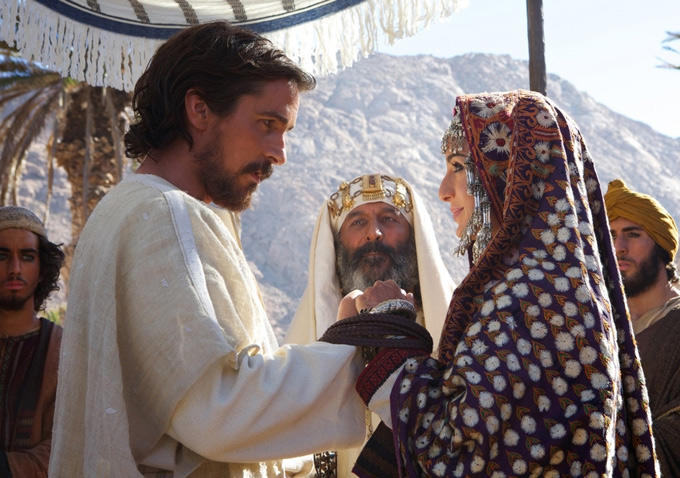
MosesZipporah—–6) Perhaps one of the few best parts of this film was the emphasis on marriage and family, especially fatherhood. Moses and his wife, Zipporah, share beautiful vows together, and the respect they show for one another is a good example of marriage. Fatherhood is shown through how Moses cares for his son, and even in how Ramses loves his own.

—–7) Another part well done are the plagues. I enjoyed seeing how the plagues were set up to be more naturalistic, including the parting of the Red Sea. As the audience, we could relate easier to the doubting Egyptians and Pharaoh who brushed aside the calamities and pushed on with their goals and lives. They saw everything as explainable by nature, and we moviegoers could too… until the coincidences got so stretched that it could NOT be mere coincidence anymore: oh… the sea level just happened to lower when the Hebrews needed an escape? Oh… the fact that only Egyptian first born children died during the first Passover? Hmmm… something tells me this was all guided by an intelligence. Wonder who that could be…

—–8) All in all, Exodus: Gods and Kings failed to insult me, and also failed to impress me. I wish it actually did one or the other, because I’m glad I don’t have to write more about this because there ain’t much here other than superficial visuals. Go ahead and watch it, but don’t be surprised if it’s underwhelming. If you’re in a mood for a more intense version, check out the original in the Bible or even the Prince of Egypt, and you’ll wish Hollywood would’ve been more creative. We were promised an epic, but got eh… Wasted opportunity, I think.

ExodusRedSea

For what I think are good reviews, see here:

1) ‘Exodus: Gods and Kings’: Theological Reflections

2) An Interview with Scott, Bale and Edgerton

My First Love Notes

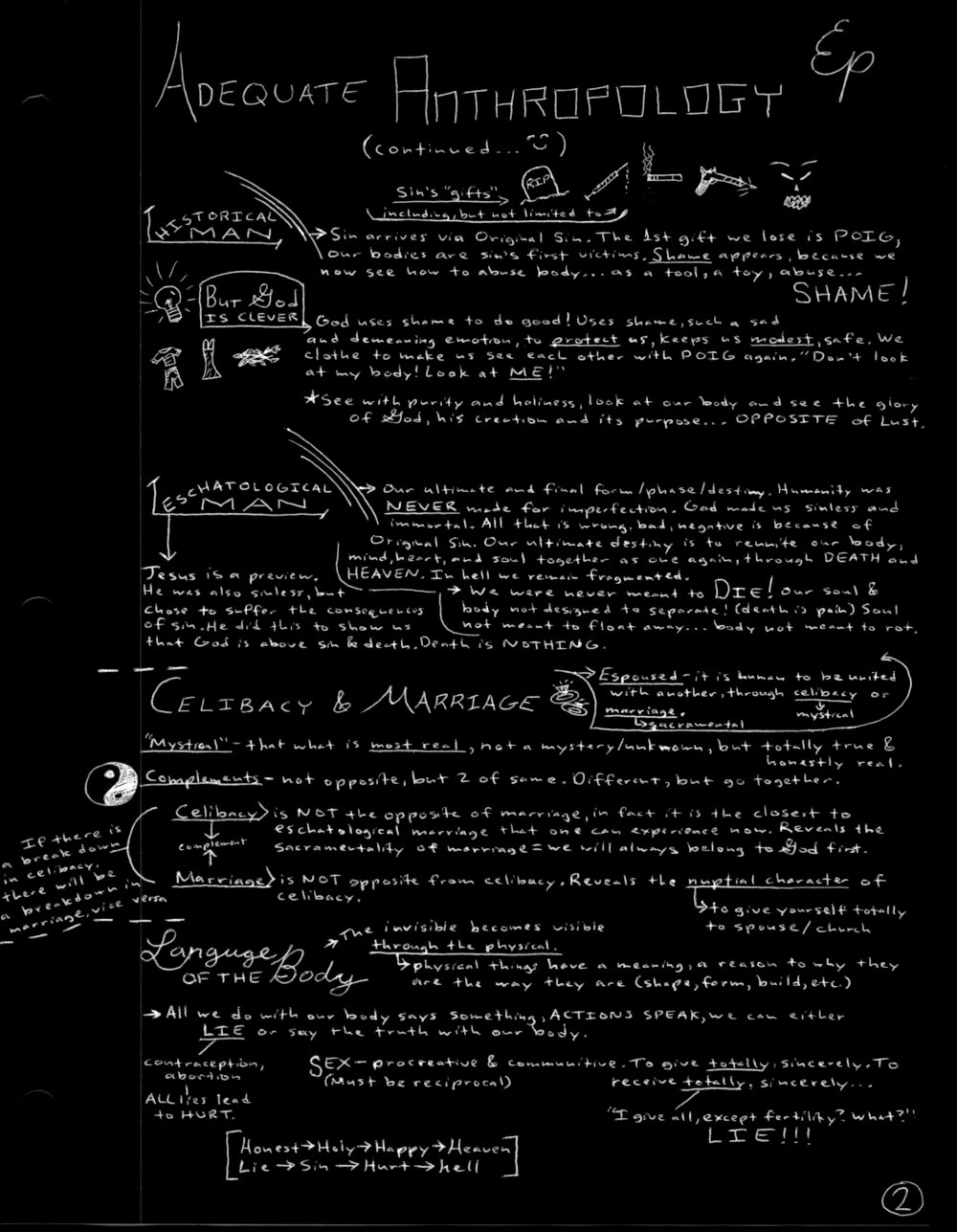
Around this time, seven years ago, Theology of the Body [TOB] became real. It wasn’t just something intellectual and textbook smart anymore. It showed me why God made me the way I was; why I have a mind, heart, soul and body; why I was not some poor soul trapped in flesh; and even why angels are kind of jealous of us human beings (jealous in a good way for the unfallen angels, and jealous in an evil way for the fallen).

Most importantly, this Theology of the Body from Saint John Paul II tore off a leech that had begun ravaging me since I was a little fifth grader. For ten years, I lived with this worm of sin, constantly tempted, perverted, and lustful. My adolescence was spent struggling for freedom, for life that was better, more beautiful and true.

And that’s when a dear friend of mine (many thanks, Mr. Dang) randomly handed me this CD that showed me exactly how I had always wanted to live — even though I didn’t know it back then. In fact, after I listened to it, I hit replay right away! I started taking notes! And it wasn’t even a class! I just had to get this down! On replay for days…

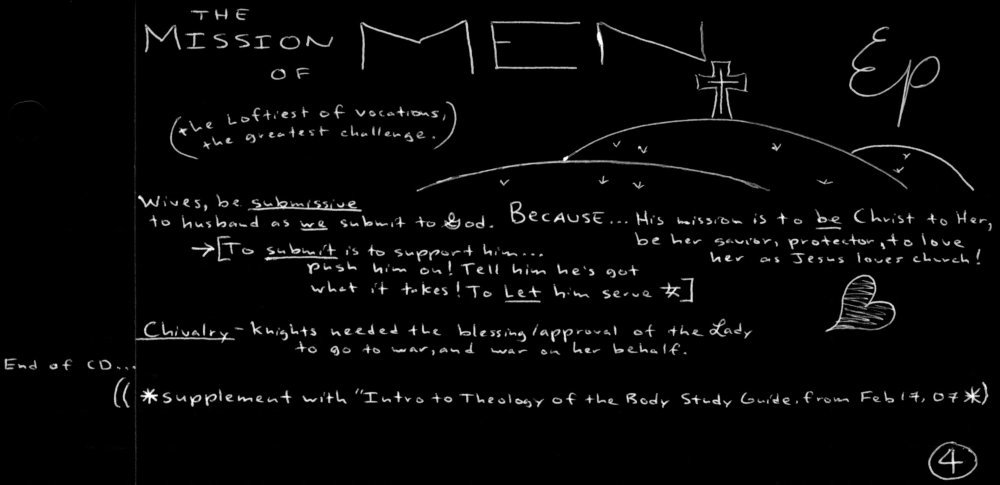
So now, attached for your pleasure and for the glory of God, made public for the first time ever: My First Love Notes (because with TOB I was finally starting to learn how to love)…

Click here for more of my TOB posts.

Introducing: The THIRD Way

“There are not 100 people in the United States who hate the Catholic Church, but there are millions who hate what they wrongly believe to be the Catholic Church.”

-Archbishop Fulton J. Sheen

It is sadly true that we Catholic Christians do not know much about homosexual attraction and how it affects people, and it is even sadder that many others know even less. But, let’s stop the ignorance, stop the hatred and misunderstanding and finally know what the Church actually proposes to us.

This short film is a great first step. I personally have waited for something like this for a while: a compassionate and honest look, a loving and fair response to an issue that is so stained with pain, malice and evil on both sides.

Well, this here is the THIRD side, this here is the THIRD Way:


The Dark Knight Fails

Dark Knight Rises

The Dark Knight Trilogy is by far my favorite in film history. Many things were simply done right in the story, but a few things could’ve been better. But since I have a reputation for nitpicking the negatives, I’ve decided to write about more redeeming things.

Except…Miranda and Bruce

Do you remember the scene in The Dark Knight Rises, when Bruce and Miranda share an intimate night together in his lonesome mansion? Yes – the scene that didn’t need to be in the movie at all. Yes – the scene that was followed by a silly shot of Batman overlooking a Gotham sunrise, standing atop a skyscraper, triumphantly posed as if he just accomplished a rite of passage into manhood.

Batman Surveys Gotham

Yes, that one-night-stand between Wayne and Tate. What was it all about? Why have it in the storyline?

Here’s what I think (SPOILER ALERT):

In Bruce’s loneliness after being abandoned by business, boss, and butler, he finds a lovely young woman in Miranda – someone also interested in him. Together, they share something proper only for a married man and woman to share. But it doesn’t end there.

Every act of love-making has consequences. And in this case, Bruce just cursed himself. How so?

1. Miranda turns out to have been only using sex to gain Bruce’s trust (where Bruce was using love only to gain sex).

2. As a consequence of using and being used, Bruce falls for someone out to manipulate him even more. Miranda is Talia al Ghul, none other than Ra’s al Ghul’s vengeance-bound daughter out to finish her psycho-father’s plan to terrorize Gotham.

3. Because of Bruce’s weakness and lust, he fell for Talia’s treachery, which made him overlook a lot of clues a virtuous Batman would’ve noticed sooner and used sooner to track down Bane and the League of Shadows resurgent.

4. Finally, Bruce’s weakness and lust betrayed Selina – his true love, his true friend and companion, despite her stained history. Because he gave away the gift of his body and love to Miranda, he failed in keeping himself for Selina, and that deprives Selina of what she rightfully deserves as Bruce’s bride.

If you are hoping to find your spouse one day, please think of him or her right now:

Men: she’s out there somewhere, waiting to meet you. Wouldn’t you want her to be keeping herself, saving herself for you? Shouldn’t you do the same?

Women: he’s out there looking for you, eager to meet you. Wouldn’t you want him to keep himself, save himself for you, because of how special you are? Shouldn’t you do the same?

[Happily Ever After...]

[Happily Ever After…]

Professor-X is a Priest!

ProfXI’m not an X-Men fan, so forgive me if I get this wrong, but Professor-X did something pretty superhuman once, when he was a young man.

Duh, right? Charles Xavier is a telepathic mutant, of course he can do superhuman things: read minds, erase memories, create dreams and illusions. But I bet you missed one in the film X-Men: First Class. I almost missed it too! Until I watched more carefully, more thoughtfully.

MoiraCharlesIn the movie, Charles meets and becomes friends with a CIA agent, Moira MacTaggert. Throughout the story, the two grow closer and their alliance matures into friendship, and in the end, their friendship blossoms into a sweeter love. If you haven’t watched the film yet, sorry — deal with the spoiler!

So in one of the last scenes, Moira leans down to kiss the paralyzed Charles. And there it is! That’s when it happens! That’s when Professor-X rises to the challenge.

Professor-X chooses the discipline of celibacy.

Not because he doesn’t love Moira, not because he wants to be lonesome, not because he’s afraid of marriage and sacrifice and fidelity.

Nope. Professor-X chooses celibacy because he cares so much about Moira, because he’s responsible for way too many others to just marry and live a simple life with her, because he can’t live a simple life — period! — and because he wants to live a life of extreme sacrifice and fidelity for others (mutant or not).

Professor-X chooses what all solid Catholic priests choose. A priest, in a sense, is a man who cannot love just one, but desires to love many and to lay his life down for their lives. He wants to offer his maleness, his masculinity in a way that serves others, and not merely himself. He becomes a brother to all, a son to all, a father to all.

Celibacy allows a man to live simply, to have the ease of going off on a mission at a moment’s notice. He doesn’t have to worry about who to care for first, whose attention he should tend to first. The question: “My family, or everyone else?” doesn’t happen to him. Because in celibacy, “everyone else” IS HIS FAMILY.

And that’s what Professor-X realized. He needed to overcome his natural, good and human want to marry a woman and start a family with her. He and celibate priests choose to go beyond the call of nature and love more, and more, and more.

This goes for religious sisters and nuns also! They choose to be a sister to all, a daughter to all, a mother to all. It’s for the same superhuman reasons, and since it’s superhuman, not all persons desire it, and even less achieve it: the level of love involved and demanded is intense.

That leads us to this common misconception: “If priests aren’t allowed to marry, then they will act out their desires in horrible ways, like abusing children and others!”

But think about this: If a man marries so that his desires won’t come out in horrible and abusive ways… then I feel scared for his wife and kids! Marriage and love is not some sort of release valve for a lustful and abusive person! If that’s how the man is, then for the sake of humanity, keep him away until he grows up into a real man: someone who follows that love is sacrifice for the good of others, not for gaining selfish pleasures!

Any man who sees marriage as some release valve for his desires should never marry, and should never ever be a priest. He must master his lust first: he must let God’s grace transform his restless lust into restless and selfless service. He must rise to the superhuman challenge. Because women deserve better, don’t they? Because the Church deserves better, doesn’t she? Because all of us children deserve better, didn’t you know?

Papa to the world

And Grandfather To All!

P.s. Even Professor-X’s name gives it away! “Charles FRANCIS XAVIER”? Come on… like what Catholic hasn’t at least heard of Saint Francis Xavier?!

P.p.s. The discipline of priestly celibacy goes even deeper than these practical reasons, but that conversation is for another time.

Just Too Beautiful

I once heard a friend say this, and what she said shocked me:

“No matter how much a man tries, he can never be a woman. Women are just too beautiful.”

I agree with my friend.

No matter how good technology gets, no matter how advanced surgery gets, and definitely no matter how much effort, money, and care it takes – no man can be a woman. He will never smell as good, look as good, feel as good – and absolutely never be as beautiful.

Because a woman’s beauty and a man’s beauty are not the same, not equal, not interchangeable.

A woman is as different as she can be from a man – and still be 100% human. A man is as different as he can be from a woman – and still be 100% human.

Anyone who believes a man can become a woman must also believe that the night sky can become the stars, that the frame can become the painting, the page can become the story, the dress can become the body.

Starlit

But no matter how similar the two – it is impossible for one to become the other, because the one is meant for the other, and the other for the one.

But it is understandable why any man would want to become a woman. Who does not want to be beauty? Who does not want to be the person he most adores, admires, cherishes and loves?

So did men get cheated then? Did men lose out somewhere in the scheme? Did we get suckered out of the bargain?

No.

No, because when man holds woman – he supports the stars, he protects and presents the painting, he carries the tale, he embraces the beautiful body. He gets to hold beauty, gets to be with beauty. He gets to care for beauty. He gets to love her.

TOB Inspired,

-Evan/Even/Ivan/Evian/Ev/Evon/Kevin/Evin/etc.

[Written originally in Autumn 2012]

Why Seminary? And Why Now?

CoronationBVMIn honor of the Assumption (Dormition) of Our Lady into Heaven as Queen of Creation, I commence the blog “Holy Smack”!

Why seminary?
And why now?

I came to the major realization a few months back. It was during Lent 2013, some Sunday in February or March. I was finishing up teaching catechism classes at church. At dismissal, I came into the hall and saw the students pour out of their classrooms. So many of them, and so many of them lost, confused, and living lives of quiet desperation. Sure, they have food, clothes, houses… but how many have a home? A loving and faithful family? Supportive friends and positive influences? So many… who will care for them?

And I said, “I want to. I want to care for them.” And then I realized, “If I have my own family one day… wife and children, I would be too in love with my own family to care for these and others. How can I take care of so many if my attention is divided? My family would come first, of course…”

So I had to rethink my hopes and dreams.

Later in Lent, I started teaching English essay classes to middle schoolers in the Chinese American community (Shout out to Lily, Charlie, Jennifer, Claire, Jessica, Austin, Andrew, Kelley, and Richard!). Though I loved teaching and guiding the students, I didn’t like focusing on teaching English. Instead, I wanted to give these kids the wisdom to make good moral choices, to understand their Christian faith, and to be smart — not superstitious! I loved teaching Christian morality, theology, philosophy.

So I had to rethink what I’d do with my English degree.

Then I saw my book, the proof copy of Little Miss Lucifer, sitting on my desk. After eleven years of work, research, plotting, planning, writing, scrapping, waiting, rewriting, revising, praying, editing, etc, she was almost ready for the world. But I just looked at it and repeated Saint Thomas Aquinas’ words: “All Straw!” St. Thomas Aquinas wrote shelves of beautiful work on philosophy and theology, and he called it straw. Compared to Heaven, compared to Christ, all was straw.

So I had to rethink whether publishing would make me happy.
Even if the book were to become wildly successful, even if I wrote ten more best sellers… would I be content?

And one night I struggled to fall asleep. I began daydreaming in the night. I imagined myself in bed ten years from now, beside my beautiful wife and our beautiful children. I imagined asking myself at that moment, “What if I did go to seminary? What if I did give my discernment more effort? Would I have heard a call to priesthood? What if…?”

I realized right then, that to be fair to my possible future wife and children, that I must find out. I must answer this question in my heart. I must address the question mark in my mind. I must answer “What if?” It was best for them, for me, and for others.

Besides, not every man who enters seminary is ordained. Seventy to ninety percent of the men who enter do not become ordained, but they leave seminary more resolved to be stronger and more courageous dads and husbands. They learn to be prayerful, humble, and caring. They learn how to serve others, how to respect, and how to keep their faith. They have nothing to lose — and so much to gain.

So I decided to apply. And now here I go!