Dancing at Dusk

LastDancing HT weekend, a strange group of young Vietnamese Catholic adults gathered beside a lake in rural Wisconsin and found themselves dancing for the Lord at dusk. The following is video footage providing evidence of the ocurrence, and that Evan has learned to shed his shyness of the camera (with much gratitude to the fellow dancers and videographer!)

Yet, before (or after) you enjoy the evidence, please consider why it is that we dance? Why is it that we find it difficult to sit idle and still when a good song comes on? Why can we not brush off beautiful music, or ignore terrible music either? Why do we respond with shudders or dancing?

These are questions for the Theology of the Body to answer, and without drilling into the depths, I’ll say this for now: we have bodies. We were made body-soul, and our body makes visible our invisible soul. Music is a special art that cuts easily into the soul, and depending on the type of music (yes, there are types we should avoid), we respond physically and in certain ways that make sense.

So with these two songs presented below, I’d like to say that I did not sit down and draft out the movements in a technical and premeditated way. Instead, I listened to the music and moved the way the music steered me.

And many others can move way better than I. But this is my blog, so hah…

Lego Movie Theology

LegoMovieWhen I first saw the trailer for The Lego Movie, I thought: “Dude, who wants to watch Legos when you can play with Legos?” But now I realize: why not do both?

So after reading the ever trusty [soon to be Deacon] Steven Greydanus’ review, I finally had the chance to see the film for myself and I noticed a few things…


—SPOILER ALERT—


—–1) The movie revolves around a tyrannical perfectionist who tries to brainwash, dominate and freeze the Lego-world into what he thinks is the perfect Lego world and society. Opposite this obsessed character is a resistance group trying to inspire people to be creative, to think for themselves and use their free will.

SheenTIMERight away, this reminded me of Venerable Archbishop Fulton J. Sheen’s talk on a Perfect World versus a Moral World: essentially, what kind of world did God create… a perfect one? or a moral one? and why?

Well, we all know the world today is far from perfect. Even in the beginning, when Adam and Eve sinned, we became imperfect. In fact, even before our beginning, one-third of the angels sinned and fell from Heaven! So… if even 33.33333333 percent of the angels crashed, what in the cosmos was Almighty God thinking when He made everything?
Again, we can see here that God had two choices: make a perfect world, or make a moral world (not quite the opposite of perfect). And obviously he chose a moral world. That leaves us to ponder: WHY?????!!

Because a perfect world would mean he is a puppetmaster, an overlord, a slavedriver, a Matrix. He would call all the shots, make all the moves, think all the thoughts, and do all things done. There would be no possibility for anyone else to have freewill, self-determination, self-mastery, etc., etc…. including LOVE.

That’s right — if God created a perfect world, there would be no love, because we would all just be programmed to love, we would all merely love because we would be forced to. And if love is forced… guess what? it ain’t real. We need to be able to decide to love. If we cannot choose, we cannot love. This is why we inherently feel there’s something off about a 100% arranged marriage (some parts may be arranged, but to the point of forcing the man and woman to join against their will? that’s not gonna fly in the Faith.)
HelixNebulaSo God took the humongous risk: to create so that his children have free will. Free will for what? Free will to decide if they will love each other, to love Him back. If He forced them to love, that’s not good enough because it ain’t real. So He let us choose, and many choose not to love others, not to love Him… but those who do choose love, well then their love is true, real, free, total, faithful, and fruitful (or at least become that way eventually).

God made us with freedom not so that we can do whatever we want, but so that we can choose love. Love was worth it for God to forsake perfection. Love is always worth it for Him to forsake perfection. And if even He believes so, then we should also believe perfection is worth losing for the chance to love. And once you have real love, then the true creativity begins, because no one creates something to hate it, but to love it!

And last thing: God is the only person who can make something better than perfect… over and over, for forever. What was great, He can make even greater. What was super, He can maker superer (I know that ain’t real word), and yes… what we think is “perfect,” He can upgrade into eternity.

—–2) There’s a line in the film where Morgan Freeman says: “Sometimes you have to believe in order to see.”

Well, as awesome Freeman is, this line is not his. Saint Augustine already thought this thousands of years ago, and I just learned this a few months ago! A lot of people think we need to see something before we can believe it, like an “I’ll believe it when I see it!” kind of attitude… but actually, the reverse is more important!

If scientists didn’t believe in the logic of the scientific method, if they didn’t believe the laws of nature were consistent and non-contradictory, if they didn’t believe the facts and the data, then they would never see the truth. They would be closed to their own illusions, unable to see the intricacy and complexity of what they observe.

This also goes in our relationships: if we don’t believe our mother loves us, if we don’t believe our father protects us, if we don’t believe our siblings care for us, then we will always be suspicious of them, make up reasons to think they’re untrustworthy and lying, make up a fantasy that fits our disbelief.
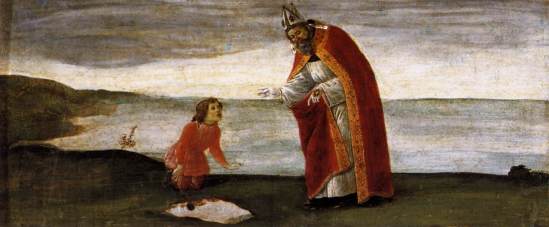
Augustine and ChildThis is similar in our faith in God: if we don’t believe He is real, we will not know how to see Him. If we don’t believe he could be real, we will not know where to seek Him. If we don’t believe, we close our mind (and heart) to Him and will make up reasons that explain Him away instead of thinking more, meditating and contemplating into the deep.

And so, keeping an open mind involves leaving the window open, but also keeping the screen on… since there are always pests that want to sneak in and distract you.

—–3) Lego is successful because it teases our creativity. There’s a line that Saint John Paul II once said: “Man is, in a sense, condemned to create.”

When I first heard this, it hit me hard, because it’s so true. Our creativity is a powerful gift. We can create — like no other creature can! Our cities, stories, songs, sagas, civilizations… our arts, technology, cultures, societies… these are amazing things. Yet, at the same time… these can be a burden, a curse, a condemnation to us. How many times does an artist slave over her work? How many engineers become workaholics? Creating is laborious, tedious, and exhausting… yet our creativity drives us on (like right now… I should stop writing to get to my studies, but… just… one more… sentence!). Creativity is a mixed blessing, given to us by God. I only hope we use it for love and not evil.

LegoEnemy—–4) Finally, we see in the film an example of the best way to crush an enemy: by making him into a friend. After all, if you kill your opponent, he dies as your enemy, he dies in evil ways (assuming you are right and he is wrong) and you become his killer. But, if you can win him over, get him to understand and believe in your cause, then he becomes an ally, a friend, and the evil in him dies and leaves nothing left but love and friendship. The person is not the enemy, but it is the evil he thinks, believes and does that is the true enemy.

That’s all I got! I hope you enjoyed those insights! Thanks for reading. Now go play with some Legos!

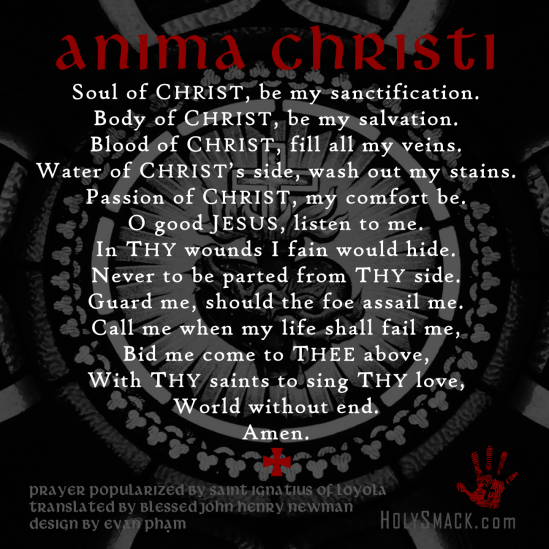
The Anima Christi

On this day, after the Feast of the Exaltation of the Holy Cross, when we remember Our Lady of Sorrows, may I present the newest addition to the Holy Smack Holy Card Collection: the Anima Christi [Soul of Christ]!

This card showcases the Sacred Heart of Jesus with the Anima Christi prayer in the original Latin on one side, with an English translation on the reverse. Popular belief claims that St. Ignatius of Loyola composed the prayer, but others believe he merely popularized it. This English version is given to us by Blessed John Henry Newman — an Anglican priest who became a Catholic cardinal after researching Church history far enough and critically enough to see that the one, true Church is the Catholic Church.

Personally, I love praying the Anima Christi after receiving the Holy Eucharist.

AnimaCardLatin


AnimaCardBack3


Praying and Praising with Audrey Assad

The first time I encountered Audrey Assad‘s prayer through music, I was stunned silent. It was during an August sunset, and she was only a guest appearance during Matt Maher‘s charity concert. Before this point, she was only an unknown backup vocalist… but when she started singing her Restless… nobody wanted her to be merely a backup anymore.

Audrey AssadYesterday night I had the chance to see Audrey again on her final tour. So much of it felt like a reunion of sorts, but I also noticed and appreciated the beautiful and subtle ways she has changed since 2010’s experience.

She was not center stage this time — not even close! She put herself off to the side, and made sure icons and masterpieces of the Faith were our focus. The artwork would appear distorted at first, and only gradually become recognizable as we prayed with Audrey through song.

And she didn’t just sing, but she led us in prayer. She moved away from the mic and would let us take over — hinting to us that our voice is beautiful too. We needed to pray while she hushed.

And hushed… and hushed until she backed away from stage, unknown to us. She left us praying and praising Christ at the end, herself decreased to the point of absence, Himself increased to the point of sole presence.

It was clear she wanted to remind us that we were gathered there for Jesus — not for anyone else, not for her. Even after the whole show, she was nowhere to be found, because she wanted us to find Christ instead.

And I think a lot of us did find Him.

As my brother seminarians and I drove home after, we prayed and praised God the whole way. I really don’t think the other fans were doing anything different either as they went home that night.

Thank you, Audrey [and Bellarive!] — may Mary keep you and your beloveds close to her Son’s Sacred Heart always.

Some favorites:

Lastly, check out this post for how to move to Audrey’s You Speak… yes, you read right: move. As in dance. With me.

“Heaven Is for Real” Made Me Cry… a little

Heaven is for RealBefore I begin, let me say first that I did not love this movie. It has great space for improvement (cinematic, theological and Scriptural), and I’m glad it didn’t cost me to watch it. Having said that, here’s a positive moment that I walked away with:

— SPOILER ALERT —

It takes quite a bit from a movie to make my eyes water. But, I’ve been noticing a winning recipe…

Mystery SisterIn Heaven is For Real, I was quite surprised they could dish it up. The scene that got me was when Colton tells his mom about his long-lost sister. When his mom asks how she looked like in Heaven, and what was her name, Colton says: “She looks like Cassie, but with your hair. And she doesn’t have a name. She said you never gave her one. She said she died in your tummy.”

This mystery sister was miscarried at such an early stage that her parents didn’t know her sex, and so left her unnamed. That part got me big. That this girl had no name. That even those who die before their birth deserve a name was evident in how brokenhearted Colton’s mother felt when she realized her little girl still went nameless.

And I hope you see how important this is. Everyone deserves a name, and God would actually give us such a privilege as to name our children for eternity. God does not directly name us… our parents do! And if we too become parents, then we name our children, and they will bear that name forever. That is the name other people will know them by, that is the name the angels will know them by… that is the name that God will know them by. Forever, into the ages of ages.

What kind of God do we have, who creates all and knows all, would allow us to name someone with a name that even He would have to use to address? He created this person! He loves this person more than any other can! And He let’s us name His beloved?!

I hope we don’t make light of this privilege.

P.s. If you didn’t notice, Adam was the first human, and he was also different from all the animals in many ways, including that he was given the privilege to go out and name everything else in creation.

[“Adam” by Theresa Dawn]

The Avatar and the Pope and the Passion

KorraMy brother first introduced to me Avatar: the Last Airbender eight few years ago when it was still on TV. And since The Legend of Korra (LOK) started airing, I’ve been more and more surprised by how much goodness the two series has. Not only is the story tightly writ, but the characters also exhibit virtues (sacrifice, pro-family and pro-life) and the overcoming of struggle, as well as dealing constructively with the consequences of bad decisions. Both series are very mature, not merely for kids (in fact, there’s a lot that only mature viewers could grasp).

Anyway, I’ve been waiting for an excuse to post about the LOK, and this weekend’s season finale really gave me no way to ignore posting. Here we go…

SPOILER ALERT

PopeFrancis     1) Though the show involves reincarnation,* the line of unbroken succession from Avatar Wan to Avatar Korra hints very much at the Catholic line of unbroken Apostolic succession from Saint Peter to Pope Francis.

This is especially interesting since though each avatar is carrying on the “spirit” of the past avatars, each avatar is still unique (which seems to go against true reincarnation)! Korra is not Aang is not Roku is not Kyoshi is not Kuruk is not etc. Just like how Francis is not Benedict XVI is not John Paul II is not John Paul I is not Paul VI is not John XXIII is not Pius XII is not etc.! Each pope continues the office of Bishop of Rome (aka: the Papacy) as an individual, just like how each avatar continues the office of Bridge between the Human and Spirit Worlds (did you know “Pontiff” [one of the Pope’s titles!] comes from the Latin Pontifex, which means “to make a bridge”).

And if this symbolism isn’t enough, it hit me recently that when a pope leaves office, the next pope is always a surprise choice! That’s the same with the avatar! Nobody knows who the next avatar will be, just like how nobody knows who the next pope will be. It’s all up to some unknown power (Holy Spirit!) working with the Conclave that determines the successor!

     2) Another point: at the end of the Legend of Korra’s first season, we see her being guided and nurtured by all the past avatars. This, to me, amazingly presented what we Catholics believe about the Magisterium and Church Tradition, in that all the saints and popes and bishops of the past have left us with a huge counsel that we can refer to in time of confusion regarding Church teachings. Their prayers, intercessions, writings are all available to the Church to help guide and nurture us! When I saw the army of past avatars backing up Korra in her darkest moment, I saw something very much like the Communion of Saints. It was beautiful, and we as Christians have that with us as the cloud of witnesses that St. Paul mentions in Hebrews 12:1.

[the Crucifixion of St. Andrew by Peter Howson]

[the Crucifixion of St. Andrew by Peter Howson]


     3) At the end of LOK’s third season (the 1st and 3rd seasons deal with very mature themes), I couldn’t believe what I was seeing. There Korra was, willing to sacrifice herself to save an entire people (and the world). When she was bound, the Red Lotus (like the Pharisees) fixed her limbs into a CRUCIFORM. Yes, it was not an actual wooden cross, but the X-shape is exactly the same as how St. Andrew was crucified for his love of Christ. And not only that, but Korra struggled greatly to restrain her power; just like how Jesus refused to manifest his divinity and come down from the cross… Korra also refused to enter the Avatar State. She suffered on the X (which isn’t much different from a t), and her agony reminded me of the Passion of the Christ. Even the poison that the Red Lotus inflicted on Korra was symbolic: the venom was metal based, as the nails in the Crucifixion were metal based. The venom was applied onto Korra through her arms and legs, as were the nails were driven through Jesus’ wrists and feet.

Korra on the CrossAnd finally, when Korra fell under the effects of her crucifixion, her father holds her in a way that mimics the Pieta, when the Blessed Mother holds her Son. At Jesus’ death, the devil howls and laughs in victory (presumably), only then to discover that the Resurrection is God’s last laugh against sin/death/evil. The same happens in LOK: Zaheer laughs out loud (I refuse to type LOL, even though I just did), only to recoil in outrage and horror when Korra is revived after the extraction of the metal (poison/nails) from her body.

Here’s a big difference though: Korra is greatly wounded by the persecution, to the point of being restricted to a wheelchair. Exhaustion and sadness is obvious in her eyes. She won, but certainly looks defeated — not much different from a zombie. Contrast this with Jesus after His Resurrection! He is teleporting all over, visiting His loved ones, cooking breakfast for his apostles, taking hikes and roadtrips, even sharing stories and rising to Heaven! So obviously, Korra (and the other avatars) is not presented as a god in any way. She is mortal. Don’t get it twisted.

     4) And so, I look forward to what the writers (Michael Dante DiMartino and Bryan Konietzko) of this series have in store for following seasons. They have not let me down these past nine years since 2005’s first series’ launch. May the Holy Spirit bless and inspire them to create greatness. I mean, they did hire the very Catholic Gene Yang (author of the Rosary Comic Book) to author the comic series that told the story of Zuko’s long-lost mother!

*a note regarding reincarnation: if it were truly real in the show (and in real life), then why bother trying to save others? It wouldn’t make a difference to save Korra, just let her pass on and return via another life (instead of having her continue to endure her present life through a broken spirit and body). Unless… unless it’s true that we are all unique and unrepeatable individuals who are worth saving at every effort. Unless… it’s actually more meaningful and more beautiful to believe that we all are special and have our own customized destinies. In short, I disbelieve the existence of reincarnation because it’s simply meaningless and not beautiful. Reincarnation shows me nothing but a vicious cycle of hopeless repetition. My Catholic Christian faith shows me that God is love, truth, beauty and goodness. Don’t mind me if I’d rather have faith in that.

**Lastly, considering the writers have already exhibited blood-bending (water), and breath-bending (air), I only wonder when bone-bending (earth/minerals) and brain-bending (electrical neural activity) will be manifest. I truly appreciate that they used these frightening prospects only to serve moral stories (and not mindless mayhem), and also have shown restraint in presenting these terrifying abuses of power.

For the HolySmack take on more of Korra, including the series finale, check here: Closing Thoughts on Korra

Lesson Resources from ALL TNTT Training Camps

Hello beloved HT of TNTT (and any possible eavesdroppers),

This post refers to the various training camps I’ve visited since 2013. (Lincoln, NE; Stockton, IL; Miami, FL; Epworth, IA; Buffalo, NY). If you were at any of the Sa Mạc lessons that I had the honor of presenting, here are the extra resources and information just for you, as mentioned and promised:

—–1) Marian Devotion Workshop:assumptionweb1

  1. You can find the text of my testimonial about meeting Mary here, and the worksheet here.
  2. Rosary Comic Book: great for all ages. If you haven’t seen it or prayed with it, you must check it out. My favorites are Gene Yang’s depiction of Mary’s Assumption and Coronation. (As of today, the book seems to be hard to stock… so get yours now!)
  3. When I was at my 8-Day Silent Retreat, I picked up The World’s First Love and fell in love with our Lady. You might, too!
  4. The ancient Latin hymn I may have chanted to the Queen is known as the Salve Regina

—–2) Adoration & Benediction Workshops:

  1. In the silence of the heart, You Speak (and when God speaks, we listen!) [and this is my official movements to the song!] Remember to use this only before Jesus is exposed, or before you enter His presence in the monstrance.
  2. The official Holy Hour Guide from the Institute of Priestly Formation! Seriously, I found this very helpful for getting the most out of my Holy Hours with the Lord. I used this multiple times during during multi-day silent retreats.
  3. Detailed rubrics for proper Benediction and Adoration protocol (please follow this in detail to prevent sacrilege).
  4. Handy brochure to print and share with adorers during Adoration (semi-Việt version here). If you want a customizable version for you to tweak, please email me at EvanPham@HolySmack.com
  5. Document on how to prep adoration for Knights of the Eucharist (HS), how to prep for Companions (NS), for Seekers (TN), and for Seedlings (AN).


—–3) Living a Eucharistic Day Workshop: Handy brochure to encourage and guide your Eucharistic Day (Sống Ngày Thánh Thể)

  1. Also check out this post: You Are What You Eat (remember my example with strawberries?)

—–4) Sharing Sacred Scripture Workshops:

Handouts to prepare for: Seedlings (AN), Seekers (TN), Companions (NS), and Knights (HS)

  1. The 2nd Edition Revised Standard Version – Catholic Edition (RSV-CE). I love this Bible… the leather bound and hardcover versions are bomb.
  2. Study Bible of the 2nd Ed. RSV-CE, aka: the Ignatius Study Bible. For now, only the New Testament is available in one volume. The Old Testament is being put together right now, and so is only available in individual issues (I have the Genesis issue, which is amazing… I used it to create HTDT based on the whole Torah/Pentateuch). Dr. Scott Hahn is one of the faithful minds behind this study Bible.256x256bb
  3. Free app to read the whole Bible with interactive and in-depth commentary from the Church Fathers. Don’t miss out on this neat tool, called Catena.
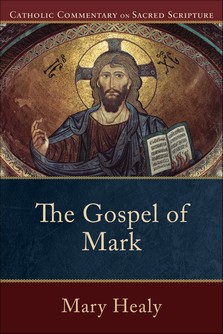
  4. Catholic Commentary on Sacred Scripture: this series on the New Testament is indispensable for anyone who wants to know the way the Church reads the Word of God. I highly recommend starting with the Gospels (my seminary’s Scripture classes use this series).mark_small
  5. Pocket Guide to the Bible: great introduction to what the Bible is, its history, how to use and read it, and how it’s organized.
  6. Where We Got the Bible: something I read to learn how the Bible came into existence, and how the Catholic Church assembled it and maintained it throughout the ages. Pretty fascinating, considering the Bible is the Church’s book.
  7. If you really wanna get into more Scripture treasures, then read anything by Dr. Scott Hahn and listen to his talks on YouTube. He’s a great speaker to start with. A Father Who Keeps His Promises is a great treat for us who want to know the main theme of the Bible.
  8. Great Adventure Bible Timeline of Salvation History: we all prefer a slick timeline chart instead of a chunk of words, so this is a great visual aid to exploring how the Jews, Jesus and His Church all fit together.
  9. And most importantly, an online Bible in Greek, Latin and English, if you’re down with exploring the Scriptures in the ancient Biblical languages (I haven’t found one for the Hebrew, yet).
  10. The BibleSmack Game (yep, I finally found a good name for it!). Here are BibleSmack‘s rules and files you need to play this game with others:


BibleSmackNewTestament Cards

BibleSmackOldTestament Cards


—–5) Theology of the Body and Christian Morality: see my ToB collection here.


Remember to send me any questions you may have; you’re always welcome!

← Back

Thank you for your response. ✨

TNTTLogo

How Women in Veils Inspire Males Like Me

[The following post is in honor of Pope Saint Pius X, whose memorial is today, and the Coronation of the Blessed Virgin Mary, which we honor tomorrow.]

Ever since I rediscovered the Extraordinary Form of Mass for myself, being Roman Catholic has never been the same. In fact, three big markers pop out of my timeline of Catholic living: when I encountered the Theology of the Body, when I met Mary, and when I discovered the Tridentine Mass.

Over the past few years of attending Tridentine Masses whenever I could (each time a wonderful treat!), one of the things most noticeably distinct to me are the number of women — young and old — who don the chapel veil (aka: mantilla). I always felt different at Mass and worship in the presence of these women in veils, but I didn’t know why (or how so) until this past weekend in the most unlikely of places…

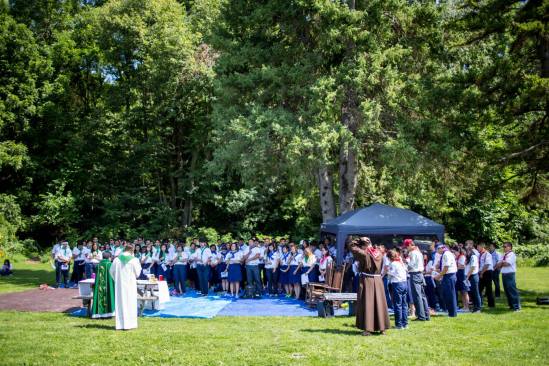
Mass at CampI was at the Midwest’s annual weekend training camp for leadership in the Vietnamese Eucharistic Youth Movement of America. Just before our opening Mass in an open field, in the humble shade of a tree and under the gaze of the morning sun, one of my dear friends beside me pulled out a white lace veil and draped it over her hair. It was out of the corner of my eye, but I saw everything in slow motion. I could not believe what I was seeing, and how it lifted my heart. Instantly, I felt a rush of reverence: if she could humble herself so much before Jesus… then how much more should I long to join her in worshiping Him! Her simple gesture to honor Christ floored me, and inspired me to show at least as much reverence.

And then, I found out she was not the only one. Throughout the Masses we shared at camp, I saw another young woman under a veil. As she approached Jesus in the Eucharist, as she knelt before our King and received His Communion, I found myself no longer able to stand before the Lord. The simple and passing beauty of the scene between the King and His daughter made me feel unworthy of beholding it so. I turned my eyes down… I wanted to crawl to Communion because my soul could sense the holiness present. My humble little heart could not handle the beauty.

I know not why it was this setting, this weekend, this event that helped me see how women in veils could help males like me worship, but I praise the Holy Spirit for the gift of this experience, for the gorgeous gift of these women. Thank you. And to further the glory of God, I asked these women to personally share with you their beautiful story…

I’m an all-in-kind-of girl, and as of that, I’ve come to realize that my inability to commit partially is both a blessing and a curse. In any case, it is most definitely the reason why I usually find myself, either, fatally wrong or unshakably confident.

My decision whether to veil or not to veil was no exception. Unbeknownst to me, my discernment process started a few years ago as casual curiosity and admiration. I didn’t have any strong feelings towards it, other than, “Wow, that’s beautiful and holy looking……. I probably shouldn’t wear it.”

But then, through my encounter with the Theology of the Body and the Blessed Sacrament, my understanding for the Church, worship and the nature of God developed — and I wanted to participate in my faith more fully.

It started with my decision to dress more modestly — by replacing my skimpy bikinis with one piece bathing suits.  I avoided controversial situations, like getting drunk while bar hopping in leotards — or just getting drunk, period. (I’m not really sure why I ever thought that it was appropriate to wear leotards as a complete outfit). But bit by bit… all these little changes restored my self image as a child of God. It helped me see myself how my Creator intended me to be. I became more aware of how I needed to represent myself as part of Christ’s body, so much so that I became uncomfortable when I misrepresented myself — and thus misrepresented Christ.

But the holy smack didn’t happen until a few months ago, when I was listening to Tim Staples, an apologist, talk about how Catholics are missing the point of Mass. It’s not just about us ‘getting fed’ but instead the Mass/Sabbath is a day, set aside to give God the praise and worship that is just.  It’s the time to fall to our knees to ask for forgiveness, grace and mercy. It’s the time to glorify Him and hail Jesus to be our true Savior.

Worship is not a matter of my feelings, it is our response to faith.

Furthermore, when I reflected on Scripture, and saw how Jesus references the Church as His bride. The pieces started to fall in place and I understood more clearly, what my Living God was doing. Day-in-and-day-out, upon that altar, He was keeping His Word. He was coming to us, as a MAN. He was offering Himself — completely and fully to us. He was re-establishing a covenant.

Jesus was all in.

[Korean Figure Skater, Yuna Kim, wears the veil.]

[Korean Figure Skater, Yuna Kim, wears the veil.]

This brought me to my knees — literally. I not only genuflected before the Eucharist, I went down on both knees. I am a mortal human that has been chosen to be a temple of God…! I was in the presence of a king. I was receiving Christ! And I wanted to do what was just and deserving of that honor.I begin to prepare for Mass differently. I hung onto every word of the liturgy. I humbly, surrendered and re-committed my life to Jesus, each and every time I received Him.I am a woman, claimed by Christ, Himself.So, what about the veil? Well, there’s no high theology here. It just made sense and was fitting. I want to submit myself before the Lord.  I want to embrace my role as a woman in the Church. The veil represents something that had changed WITHIN me. It is an outward sign of a commitment made in the depths of my heart and soul. So with unshakable confidence — I wear it…’Cause I’m an all-in-kind-of girl.

-Santa Thérèse

The beauty of the mantilla never struck me until reading Crystalina Evert’s blog on the Chastity Project; before, it had just been some weird headdress that old women and younger, presumptuous girls wore to Mass to show off their holiness.  Little did I know that those women didn’t wear those veils because they thought they were holy – it was because they needed to be holier.

Before Vatican II, women were required to wear a chapel veil to Mass in order to show reverence to the Lord on His day, as well showing the world that they, as women, were sacred enough to veil and be protected from the world around them.  The sacred should be veiled, as the Eucharist is protected in the monstrance, the tabernacle, and under the veil during Mass.  After Vatican II, the requirement of wearing the mantilla was taken out of Canon Law, and feminists in the 60’s denounced wearing it because they believed that it was a symbol of slavery to men and to the church, and so the beautiful tradition of the mantilla faded away.

When I read Crystalina’s thoughts on the mantilla, the idea of wearing one intrigued me, but I brushed it off because I didn’t want people looking at me funny or thinking I was getting above myself.  But the image of the veil kept popping into my head, incessantly and constantly.  I decided to pray about it and leave it up to God to show me what I should do, because if I was going to go all out Mary-style, I needed to know exactly why I would.  In the meantime I did some research on it.  I found that several First Ladies, including Jackie Kennedy, Nancy Reagan, and Michelle Obama, all wore veils upon meeting Popes John Paul II, Benedict XVI, and Francis.  If powerful women felt the need to veil themselves in the presence of the Holy See, why shouldn’t we veil ourselves in the presence of Jesus in the Eucharist?  Not only does the veil show that women are sacred, it also helps you grow into your sacredness.  The wearing of the mantilla promotes the growth of virtues such as chastity, purity, humility, and modesty, all of which are exemplified in the Virgin Mary, who is always depicted wearing a veil.

[Icon by Mina Anton]

[Icon by Mina Anton]

The more I read, the more I felt that God was calling me to be more like our Mother, and to emulate her in everything that I do. Like Crystalina, I loved the idea of being covered by the Holy Trinity and being protected by it.  My boyfriend bought me a white mantilla, which is the traditional color for unmarried women, made of Spanish lace as an homage to my patron saint, Teresa of Avila.  Wearing the mantilla makes me feel like I am alone with Christ during Mass; everyone else melts away, and it’s just me and my maker. I feel more alert, more open, more joyful, and even excited when I get the chance to put it on. I feel even more excited when people ask me about it, because it gives me a chance to share my love for the Holy Family and Holy Trinity.  I love the feel of the lace on my hair, like the caress of a parent’s hand on their child’s head.  I love the way the veil frames my line of vision when I look at the Eucharist.  And I love being able to grow closer to my heavenly Father and my Blessed Mother.

-ANonymous

“And this is why the female body should be veiled because everything which is sacred calls for veiling. When Moses came down from Mount Sinai, he veiled his face. Why did he veil his face? Because he had spoken to God and at that very moment there was a sacredness that called for veiling… Veiling indicates sacredness and it is a special privilege of the woman that she enters church veiled.” –Dr. Alice von Hildebrand

More thoughts on the mantilla from around the Catholic blogosphere:

1) I Love My Chapel Veil

2) Notes from Beneath the Veil

3)And here’s a video on the veil! 

A Look-See at Lucy

Lucy-BannerWhen the first Lucy trailer hit my face, I was about to scream plagiarism!

On a warm autumn day in 2002, I daydreamed about a girl who had an accident that fully unleashed her mind. From then on, the scenes of how she would live played out in my imagination… and eventually give rise to the raw origins of my novel: Little Miss Lucifer.

I wasn’t worried though, and am not even threatened by Lucy. The story is way different. But even so, after spoiling it by reading the plot on Wikipedia, I still wanted to see what director Luc Besson could do with such a character. Here’s what I think of Lucy:

[SPOILER ALERT]

Saint Lucy1) First, the name of the film and Johansson’s character is — you guessed it — Lucy. But who was the person who popularized that name? Who is the person who every “Lucy” afterwards was named after? Well, like most names we have in English today, those names belonged to saints who launched them into popular use. Think of MaryAndrewJohn, and yep… Lucy.

Saint Lucy was a young Christian woman who was persecuted for her love of Jesus. One of the ways she was tortured before being martyred was that her eyes were ripped out from her face. Many icons of St. Lucy depict her holding her two eyeballs in a dish.

But here’s how this relates to the movie: In Latin, the “lu” in the name Lucy refers to “light,” as in “luminous” or “luster”. When St. Lucy was blinded and murdered, she no longer saw created light (the light of the sun, stars, firelies and lightning), but instead became able to see the true Light of the World: Jesus Christ, the God who created all other lights. (Btw, notice all the emphasis and focus on Lucy’s eyes in the film and its ads.)

In the film, Lucy also symbolizes this as someone who becomes able to see more than light. She can see, and sense, the world we know as mystery. She even explains that time is the standard of defining reality, not us humans and our standards, but time. Now, I don’t agree with this because even time itself can be destroyed (since spacetime is only a product of the Big Bang), and if time itself can be destroyed, then what? Instead, what I take from this is that we do not define what is real or true. Instead, the film tells us that reality and truth exist apart from what we think of it. In short, the film busts relativism (the idea that something is true only as long as we want it to be, and that we can all have our own truths about reality) into smithereens!

Creation of Adam2) Lucy in the movie also amasses huge amounts of information. She and others believe that knowledge is the purpose of life. She gains the ability to time-travel, manipulate matter, teleport, and even control other people. There’s criticism out there that the film’s use of Michelangelo’s Creation of Adam suggests that Lucy has become god. However, if this is the film’s intention, then it cancels itself out in a few ways. First, Lucy knows a lot about how and what things are, but she does not know why: as in why is there such a thing as the universe as opposed to nothing? Why is there life? Why does she exist? Why does she love her parents (their conversation was one of my favorites in the film)? Why is there love anyway? And what is love? Why are some things beautiful and others not? Why does beauty exist?Why does anything exist at all? Second, Lucy can do a lot, but she couldn’t even save her own body from decay. Unless there’s a sequel about her resurrection, she’s a pretty flimsy god. Third, she’s an even flimsier god since she needs a cell phone to tell her friend that she is everywhere (and more on this below). Fourth, is it really enough to know something, to know all things? If you had all the information in creation, but nobody ever existed to share it with, would that be enough for you? If you knew about love and what it was, but you were never loved by anyone, and had no one to love in return… would that be enough for you? What I’m saying is that knowledge is not the purpose of life… love is! And this reminds me of a quote from beloved Pope Benedict XVI: “For those who love, you can never have enough information” — meaning that a lover never tires of discovering and rediscovering  the beloved.

3) So, what’s up with Lucy needing to use the cell phone? In fact, what’s up with all these latest mind-movies (like Transcendence and Her) showing that untethered consciousness still needs a way to be physically expressive? Could it be because God (the real One) created us humans that way? That we need the physical to make ourselves known? That “the body alone, and only the body, can make visible the invisible” (I stole that quote from Pope John Paul II’s Theology of the Body). Think about it: if I had an idea, how would anyone know about it? Unless… I used my brain, nerves, eyes, hands, skin, bones, muscles, etc. to pick up a pen and write it out. Or used my vocal cords, lungs, breath, tongue and teeth to speak it out? We need our bodies, because we are our body. It’s not just something we have, it is us.

Lucy4) And back to the beauty question from #2 above: beauty is one of those realities that knowledge and information alone cannot explain. I mean, how do we recognize beauty? Why does it exist? Why is it important to us? And don’t just think of visual beauty, but think of music, flavor, fragrance, and texture! (Yes, this movie did make me think of this, after all… if knowledge was everything, why bother making it all pretty with Scarlett and cinematography?)

5) Scarlett made me notice another thing: when her roommate was gushing about her night with a man, Lucy was totally disinterested. Lucy not only didn’t care, but even mocked it. This reminds me of why some men and women in the Catholic faith choose a life of celibate chastity. I’m thinking of priests and religious sisters (aka: nuns). That’s right! Scarlett Johansson’s character just exemplified celibacy. Here’s how: priests and nuns put the ordinary and natural desire for married sexual intimacy aside and instead choose the extraordinary and supernatural desire for intimacy with God. By living celibate lives, they’re witnessing that we were not meant merely for marriage with another person, but were meant for marriage with the Person, with God who is more real than any creature, more beautiful than beauty (since He created beauty). In the movie, Lucy knows reality more than the average person and sees that sexual intimacy is not enough for her — that compared to intimacy with supreme reality, sexual intimacy is kind of a joke. [NOTE: Catholic teaching does not say that sexual intimacy is a joke (married intimacy is very holy), only that any other intimacy is incomparable to intimacy with God.] (Click here to see what I mean (these sisters went on Oprah to share their story!) (And click here for how Professor-X from X-Men also exemplifies celibate chastity.)

6) The movie starts and ends with this voiceover: “We were given life over a billion years ago…” Notice that it says we were given life. Not that life popped out of nowhere, or that we gave life to ourselves, but that it was given to us. In that case… who gave it to us? Being given something implies there’s a giver…

7) Lastly, there’s a sort of throwaway line that Lucy says when the lead police officer warns her about people dying. She says point blank: “No one ever really dies.” Now, this is a claim Christians should know very well, since we profess to believe in the Resurrection and the Life, that we will all live forever, and not just spiritually, but bodily too! So, not sure what to make of this line from Lucy since nothing else follows it up and fleshes it out.

8) All in all, I enjoyed Lucy. It made me ask a lot of philosophical questions and hinted at theological truths. It was fun, although corny at times. I’m just glad it wasn’t a waste of 90 minutes and a free admission, and I’m even more glad Luc Besson didn’t steal my idea about a girl who goes 100%. Yet, the greatest disappointment was that Besson himself didn’t go 100% on this film.

The Masterpiece

Hey! So I made a little meme and poem in honor of God’s masterpiece:

God finished on the Sixth.
He finished everything but one.

After creating all
And doing all to be done,
Almighty He edited some…

The light was good,
But not that great.
The day was bright,
And night was easy on the eyes.

The sea was plentiful,
But not that beautiful.
The land was pleasant,
And yet it wasn’t.

The plants and flowers,
Green and all colors…
Still they lacked
Something or another.

The animals and creeping things
Of sky, land and sea…
Clever, cute, and coy,
Yet still incomplete.

So Almighty He created him,
In Their image They created
Little hungry Adam…
Curious, cared for, but lonesome.

All was good.
All was in place.
Still, all was made of mere dust,
Sand, mud, and paste.

After creating all
And doing all to be done,
Almighty He realized He wasn’t done…

He put little Adam to sleep,
Took some rib meat,
Polished and tweaked…

Eve into the masterpiece.

Masterpiece

[the golden gilded artwork is by Lorenzo Ghiberti]

© Evan Pham . September 23rd 2008

*Inspired by the Book of Genesis and Christopher West’s Theology of the Body talks on the Feminine Genius

**Click here for the continuation of this poem.