Forgiveness is For Giving (not withholding)

Hello! This post is unlike anything I’ve shared before: it’s an actual academic exegesis I wrote for my Synoptics class. You know how I sound when I write casually, now hear how I sound as a wannabe-scholar… (I promise, there are some really amazing things I learned and want to share with you!) The paper is based on one of my favorite verses in all Scripture, Luke 7:47: Therefore I tell you, her sins, which are many, are forgiven, for she loved much; but he who is forgiven little, loves little.
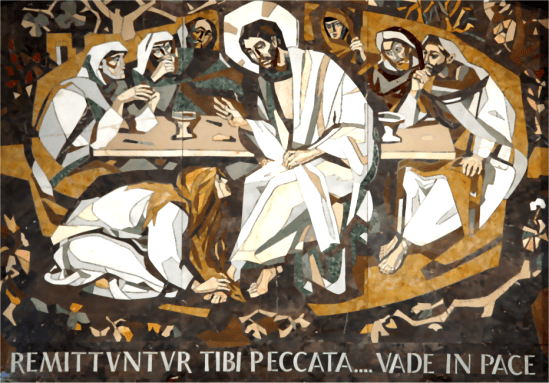
Lk7-47.png

Luke 7:41-50 (RSV)

[41] “A certain creditor had two debtors; one owed five hundred denarii, and the other fifty. [42] When they could not pay, he forgave them both. Now which of them will love him more?” [43] Simon answered, “The one, I suppose, to whom he forgave more.” And he said to him, “You have judged rightly.” [44] Then turning toward the woman he said to Simon, “Do you see this woman? I entered your house, you gave me no water for my feet, but she has wet my feet with her tears and wiped them with her hair. [45] You gave me no kiss, but from the time I came in she has not ceased to kiss my feet. [46] You did not anoint my head with oil, but she has anointed my feet with ointment. [47] Therefore I tell you, her sins, which are many, are forgiven, for she loved much; but he who is forgiven little, loves little.”  [48] And he said to her, “Your sins are forgiven.” [49] Then those who were at table with him began to say among themselves, “Who is this, who even forgives sins?” [50] And he said to the woman, “Your faith has saved you; go in peace.”

Introduction:

Ideally, the entirety of Luke 7:36-50, known as “A Sinful Woman Forgiven,” would be explored and discussed. However, the confines of this essay restrict us to an abridged reading covering only v.41-50, which exudes yet a great deal of wealth for faith that seeks understanding. The scene opens with Simon the Pharisee inviting Jesus to dine with him, which our Lord accepts. At table, a seemingly notorious woman approaches the Lord and begins to do him homage in the presence of Simon and others at table. Seeing this, Simon secretly criticizes Jesus for allowing this woman to even touch him, “for she is a sinner,” at which point, Jesus addresses a parable and lesson to Simon, and to us as well.

The Parable and the Pardon:

To help understand this parable in Luke 7, we must know the value of a denarius. In New Testament times, a sole denarius was a standard day’s wage,[1] and so in Jesus’ brief parable, one debtor owes fifty days’ worth of wages, whereas the other owes 500 days’ worth. Because the creditor cancels both debts, the difference between the debtors, with one owing a far larger amount, is important for grasping the message Jesus seeks to impart. Firstly, that the debtors cannot repay their debts, though the amounts owed would normally be repayable (unlike the debt owed by the unforgiving servant from Matthew 18:21-35), shows that perhaps unforeseen problems (e.g., debilitating injuries or disease) have arisen and made the debtors incapable of repayment. Allegorically, our debilitation is the sin of Adam, as well as all subsequent personal sin. Some bear greater sin than others, but all remain debilitated by Original Sin until Baptism, and then debilitated again with each following grave sin committed. Thus, sin is not merely debt but debilitation also.

Our Lord then says a peculiar thing in mentioning love with his question in v. 42, the original Greek of which is agapēsei (ἀγαπήσει) and means a love more nuanced toward willingness and commitment.[2] This is strange, for the business relationship between debtors and creditors usually do not involve love of any real sort, much less agapic love. Appreciation, gratitude and further indebtedness would be more fitting, but here actually lies the potential for love: the creditor in cancelling debt acts not only generously, but acts charitably,[3] acts as a benefactor who need not do such a thing out of lawfulness, but out of lavishness, out of love. Justice calls for the repayment of debt, but love becomes possible when a great debt is given, or rather, is forgiven as a gift to the debtor,[4] a gift of such immense cost that its giving transforms any stranger into a benefactor, into a lover, and any stranger into a beneficiary, into a beloved, for such great love moves the beloved to love freely in return. Thus, our Lord brings love into the parable of debt to reveal that the relationship is not one of economic basis, but of intimacy. He is priming Simon to “reconsider the meaning of [the sinful] woman’s actions – not the repayment of a debt, as though she were a slave girl or prostitute, but an expression of love that flows from the freedom of having all debts cancelled.”[5]

Indeed Simon understands, for Jesus responds that he “judged rightly” with his answer, but then Jesus does another peculiar thing. The Lord, while having turned to face the woman, asks Simon in v. 44, “Do you see this woman?” Jesus here is addressing Simon, but is looking at the woman, and doing so implies that Simon, though he sees the woman, does not truly see her. In asking Simon from this posture and gesture, Jesus invites Simon to “adopt Jesus’ own view of matters concerning this woman,” to see her as he sees her, to stand in his place and look upon her, to “no longer viewing her as [merely] a ‘sinner’ but as one who loves extravagantly.”[6]

Jesus’ address to Simon is also toward us, for we also should imitate the Lord in seeing others not as mere sinners, but as beloved siblings in Christ. Furthermore, the Lord is calling us to also love him and neighbor extravagantly, as the woman loves. From vv. 44-46, Luke’s comparison of Simon’s lack of bare minimum hospitality with the woman’s overwhelming hospitality is also an allegory: Jesus is the divine guest to the household of man. He visits not for merely his enjoyment or sake, but exclusively for ours, and is yet met not only with inhospitality, but even with open hostility from his host.[7] The allegory continues as Luke reveals the woman expresses love with prodigality similar to that of the prodigal father from Luke 15. Her experience of the Lord’s mercy and love moves her to go beyond basic hospitality that society calls Simon to provide, and so Luke compares in vv. 44-46 the coldness of Simon with the woman’s affections, presented here as a table for emphasis, reproduced from Brendan Byrne’s text:[8]

SIMON

I entered your house, you gave me no water for my feet,

You gave me no kiss,

You did not anoint my head with oil,

THE WOMAN

but she has wet my feet with her tears and wiped them with her hair.

but from the time I came in she has not ceased to kiss my feet.

but she has anointed my feet with ointment.

With the case of Simon, as the host he should have extended courtesies to Jesus, and that would have been socially enough. Yet, the woman not only extends the courtesies, but humbles herself before the Lord in ways that would have been inconceivable for Simon to have done. Simon should have provided water for Jesus to wash on his own, should have welcomed the Teacher with a kiss and anointed his head, yet the woman not only gives water, but gives water drawn from her tears of love, and dries the Lord’s feet with her own hair, which is seen in New Testament times as a woman’s pride and glory. Moreover, the woman, like the centurion from just prior in Luke 7:6, does not consider herself worthy to kiss the Lord on his divine face, but only on his feet, and does not even dare anoint the Lord on his crown, but reaches for his feet alone. Her humility in act and her extravagance in provision show her gratitude and reflect the forgiveness she has experienced from Jesus. To forgive and seek forgiveness is an act of humility and extravagance both for the penitent and the person offended: humility because pride prohibits repentance from the sinner and prohibits mercy from the one sinned against, and extravagance because parsimony restricts atonement by the sinner and restricts charity by the one wounded.[9] The allegory deepens here and finds completion in v. 47, but before continuing, the term kiss deserves special discussion.

Of the four Gospels, only the Synoptic Gospels employ the term kiss, and of the Synoptics, Luke makes most use of the term. All three Evangelists present Judas betraying Jesus with a kiss, but only Luke presents kisses elsewhere in different pericopes: once in the parable of the prodigal, and thrice here regarding the repentant woman. The appearances of kisses is telling in Luke, since his first kiss is here in Luke 7, bestowed on the Lord by a sinner on behalf of repentant sinners, and the next kiss is that of God (through the person of the prodigal father) upon repentant sinners in Luke 15’s parable. Luke’s final kiss is Judas’. One can then read that Luke’s intent is much like how he closes some of his pericopes with open endings: what will we choose next? Will we join the celebration of the younger brother’s repentance and safe return, or stay in the darkness of resentment? Will we let the last kiss upon our Lord be that of betrayal, or will we kiss him again with love and gratitude from his forgiving us?

And therein lies the conclusion of the allegory, for in v. 47, not only has the woman shown great love to the Lord for his having forgiven her,[10] but Jesus has also forgiven us our many sins and we, as the character of Simon, have yet to show the Lord such love and gratitude. We have not been forgiven little, for we have even been forgiven for crucifying the Son of God with our sins, but then why do we love so little? And why do we love not only the Lord so little, but also our brothers and sisters who are no worse than we? In fact, we who come after the Lord’s Passion, Death, Resurrection and Ascension have far more to be thankful for compared to the repentant woman, and so we also are far guiltier since we have in malice sinned against the greater gift of the Lord’s full revelation. Thus, we should in repentance and reconciliation, through the sacrament of penance, express even more love than the woman here, for we have been forgiven far more.[11]

The Lord then declares to the woman: “Your sins are forgiven,” something that at this point is already obviously clear to the woman. Rather, Luke here suggests Jesus not as addressing the woman alone, but to Simon and his tablemates who were questioning the situation, and not merely to Simon and the others, but to us readers also. Jesus here is not assuring the woman of his forgiveness (for such had been done), but is declaring to Simon and the onlookers that the woman is now reconciled with God and with God’s people and should be treated and related to as such by the community,[12] and not as a “woman of the city, who was a sinner” (v. 37). The others at table, however, are not concerned about this restoration of a lost sheep into the fold, but rather turn to critique Jesus in v. 49 with words that hearken back to Luke 5:21, when Jesus earlier forgave the sins of the paralytic. How important it is for us not to follow in such critique, which may tempt us when we ourselves are grievously wounded and do not desire our offender to be reconciled with us or with Heaven. To prevent such further resentment toward a forgiven sinner, Jesus reemphasizes in v. 50 that indeed the woman’s faith has saved her and she is free to go in peace. Here, faith is not to be misunderstood as the instrument of her forgiveness, for the Lord alone forgives, but as the requirement to even seeking repentance in the first place. Faith is necessarily bound to metanoia, for “those who reject faith reject the everlasting life that Christ offers to the world.”[13] Lastly, the peace Jesus mentions in v. 50 is not limited to the woman’s personal and “‘spiritual’ well-being… but speaks of a restoration … to the full social intercourse from which she has been excluded.”[14] The woman was once lost but has now been found.

Conclusion:

Luke closes this pericope with an open ending, as mentioned earlier regarding the kisses found in the evangelist’s Gospel. Such endings challenge readers to imagine what Simon and the others at table will do, and ultimately what readers themselves will do. Will we love much since we have been forgiven much? Will we love the Lord extravagantly, fearlessly and without shame before others who may judge us as sinful and untouchable, perhaps even as unforgiveable? Will we ourselves in turn forgive others much since we ourselves have been forgiven infinitely more?

[1] Hahn, Scott, ed., Catholic Bible Dictionary, (New York: Doubleday, 2009), 211.

[2] Catholic Bible Dictionary, 553.

[3] The word forgave in vv. 42-43 is from the Greek charizomai and connotes “by way of gift,” as in charity. See: Johnson: 127, note #42.

[4] Johnson, Luke Timothy, The Gospel of Luke, (Collegeville, Minnesota: Liturgical Press, 1991), 127.

[5] Joel B. Green, Gospel of Luke, 312.

[6] Green, Joel B., The Gospel of Luke, (Grand Rapids, Michigan: William B. Eerdmans Publishing, 1997), 312.

[7] Byrne, Brendan, The Hospitality of God, (Collegeville, Minnesota: Liturgical Press, 2015), 88.

[8] Ibid., 87.

[9] The parable of the Prodigal Son and Father in Lk. 15 further elaborates this nature of forgiveness.

[10] Johnson, Luke Timothy, The Gospel of Luke , 128. The woman’s love is the effect of the Lord’s forgiveness, not the cause of the Lord’s forgiveness, as can be misread in various translations. The preceding parable in vv. 41-43 also requires such a reading in v.47.

[11] Thomas Aquinas, Summa theologiae, II-II, q. 72, a. 11.

[12] Green, Joel B., The Gospel of Luke, 314.

[13] Catholic Bible Dictionary, 764.

[14] Green, Joel B., The Gospel of Luke, 314.

Sacred Heart of Jesus

Let me tell you the tale behind this latest Holy Smack card:

As with all of the cards, I wait for the Holy Spirit to prompt me and provide me with art and prayer to pair together into a holy card. Without the Spirit’s guidance, I do nothing. One thing that being a former seminarian has taught me is to be obedient to God’s will. And when we obey His will, amazing things happen that we could never have imagined.

With this card, I was searching for images of our Lord’s Sacred Heart. I had been on the lookout for many months, but nothing came up that rendered me speechless, until I stumbled on this blog and saw this piece. As soon as I saw Him and His heart, I knew this was the image I was always meant to find, and meant to find at that specific moment in time.

At that point, I had been going through a severe struggle in my life. Someone precious to me had been suffering in spirit and body, and like anyone who ever loved, when one’s beloved is in sorrow, one is in mourning also. Yet, when I saw this image of our Lord, the power of His light cut into my darkness. I had to find out more about the artist.

It turns out, the beaming Sacred Heart of Jesus here is a freak “accident” of flash photography! The image is a photo taken by a priest, and the blast of holy light is only a reflection of the camera’s flash. The shot was perfect, and so the priest posted it on his blog, and that’s where the digital paper trail ends, for after contacting Father, I was informed the artist is unknown, and perhaps even deceased.

And for the next four months, I deliberated and waited, I searched and listened. I found a prayer and I finished the entire card’s design, yet I still hesitated. Something was not yet in place. And then my friend shared with me more tragedy.

It was then I knew the time had come to print. The card was meant for her all along. The Lord was meant for her, His Sacred Heart was for her, the humble prayer was for her. And the card is the first to be dedicated to anyone.

Please pray for her.

Thank you, and if you happen to know the artist of the image, please do inform me so I can seek her or his forgiveness for using the image without permission.

—Updated June 8, 2018: Solemnity of the Sacred Heart of Jesus…

In honor of today’s feast, I have re-designed the prayer card (images updated below) and will be stocking up on them! Please continue praying for all to know the love of our Lord.

SacredHrtFrontSample2.png

SacredHrtBack3BleedSmall

Note: as with all of my cards, please know I would be honored to share them with you for free and that any donation would be appreciated to support the continued ministry.

My First Rorate Mass

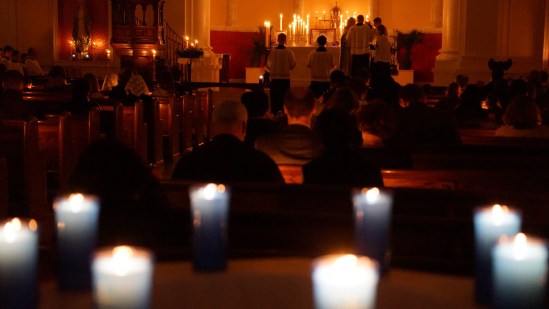
This morning was my very first Rorate Caeli Mass (please click link for stunning photos), a unique votive Mass for Mary starting in the dark of night’s end and ending at dawn, presenting for us how we are to wait for the true Light of the world (the whole point of Advent).

RorateMass-1024x490

(Photo Credit: John Cosmas)

The entirety of the liturgy is in candlelight. The shadows of the saints adorn the vaulted ceilings and walls. The altar shimmers in the firelight. The pews and handmissals glow under the candles. Everyone has their own little censer of wax, wick and fire.

Yet the moment that moved me most was the very end, at the Last Gospel (John 1: 1-14), the same Gospel read at the end of each Tridentine Mass. But today, as I was listening to the priest read the holy words, as I was wandering lost in the Latin and in the silence, waiting in the darkness of daybreak, waiting with a church full of people, waiting with my dwindling candlestick succumbing to the dark, waiting… waiting to genuflect at the very moment THE WORD WAS MADE FLESH.

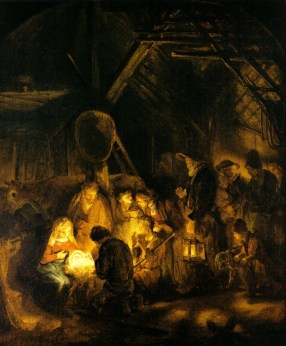
My knee hits the floor.Nativity by Rembrandt.jpg

And then I understood. God Himself came down from Heaven and hit the ground. He covered Himself in the dust of earth, clothed Himself in the mortality of man, smothered Himself in our fallen nature. Touchdown: the Lord touched the ground, touched Creation and began His reclamation. He wore our worn world, but adorned you and me with Himself, with Divinity. And the least we could do was genuflect when we remember He did all this to be with us (Emmanuel), and for us to be with Him.

The world waited for the moment THE WORD WAS MADE FLESH. And the girl the world waited for, and for her yes. The pathetic candlelights waiting for the sun. The blind and those in darkness waiting to wake. Hopeless and helpless sinners waiting for more to life, waiting for a way to become saints. All of us waiting for a way to Heaven.

Let’s stop waiting.

Because it’s all been accomplished. All that’s left to be done is for you and me to decide: will we say yes, too?

Merry soon Christmas.

*All this meaning in the simple gesture of genuflecting…

**More awesome photos of Rorate Masses around the country.

img_0518

Do What the Devil Don’t Want

In the last few years, I’ve come to see more clearly when the serpent is tempting me. I don’t always know, but it’s been easier to notice, especially when I keep in mind that I want to do what the devil doesn’t want me to do. I think it’s a pretty good motto for a Christian to live by: DO WHAT THE DEVIL DON’T WANT. Some examples:

  1. The last thing the devil wants me to do when I see a beautiful person is to pray for her. Instead, the devil would rather have me lust and abuse the woman. So what do I do?
  2. The last thing the devil wants is for me to start my day by offering it to God’s will. Instead, the devil would much rather have me forget God and go on with my life in my own selfish way.
  3. The last thing the devil wants is for me to forgive my friends when they betray me. The devil would rather me lash out and plot revenge.
  4. The last thing the devil wants is for me to ask God for help and trust in the Lord when chaos and danger happens. The devil really wants me to curse the day and turn my back on Him who is the o
    only person who can truly help me.

I think you get the trend, right?BetterWay

The better way is always the way the devil hates. So always choose the better, not the easier!

And I think you realize also that by doing what the devil doesn’t want, you almost automatically do what Jesus wants.

So do not let the devil win, because if he wins, you will always lose. But if Jesus wins, then you win too. And don’t you want to win?

Select Chants for DHHT

Hello Beloved HT of Miền Trung (and any eavesdroppers)!

This DHHT XI, we get to go a bit old school and do Adoration with some Latin chants. These chants are ancient, and the Latin is a major heritage of Roman Catholicism (stretching back over 1000 years). If you want to know more about Latin, please look here: The Romance Tongue and Why Chant Can’t Speed Up.

But, to help us all prepare, please put these three chants on repeat for the next month, and we’ll get together in mid-July to praise the King in the Church’s mother tongue. We’ve never done this together on such a large scale, so we’re a bit nervous… but let’s do this!

—–1) O Salutaris Hostia (by St. Thomas Aquinas)

Translation, history and full lyrics here.

—–2) Tantum Ergo (the last 2 verses of the Pange Lingua, also by St. Thomas Aquinas)

Translation, history and full lyrics here.

—–3) Salve Regina (anonymous and ancient)

Translation, history and full lyrics here.

Stations of the Cross

Christians around the world will soon be in the holiest time of year: the Triduum. Those few days are known as: Holy Thursday, Good Friday, Easter Vigil and Easter.

One way to help us meditate on Jesus Christ’s Passion, Death and Resurrection is the Via Crucis, aka: the Stations of the Cross. Please let me share with you my favorite set of Stations, by an artist named Sarah Gorss (please visit Gorss’ Flickr page for more information).

I particularly find these Stations beautiful and solemn. Their grittiness, and the fact they are made of rice paper really helps me feel how organic and alive the Lord’s suffering was. I hope you find these icons as inspiring as I do.

GorossStnCross01

[the first station: Jesus is Condemned to Death]

GorossStnCross02

[the second station: Jesus Carries His Cross]

GorossStnCross03

[the third station: Jesus Falls the First Time]

GorossStnCross04

[the fourth station: Jesus Meets His Mother]

GorossStnCross05

[the fifth station: Simon Helps Jesus Carry His Cross]

GorossStnCross06

[the sixth station: Veronica Wipes the Face of Jesus]

[the seventh station: Jesus Falls the Second Time]

GorossStnCross08

[the eight station: Jesus Meets the Women of Jerusalem]

GorossStnCross09

[the ninth station: Jesus Falls the Third Time]

GorossStnCross10

[the tenth station: Jesus is Stripped of His Clothes]

GorossStnCross11

[the eleventh station: Jesus is Nailed to the Cross]

GorossStnCross12

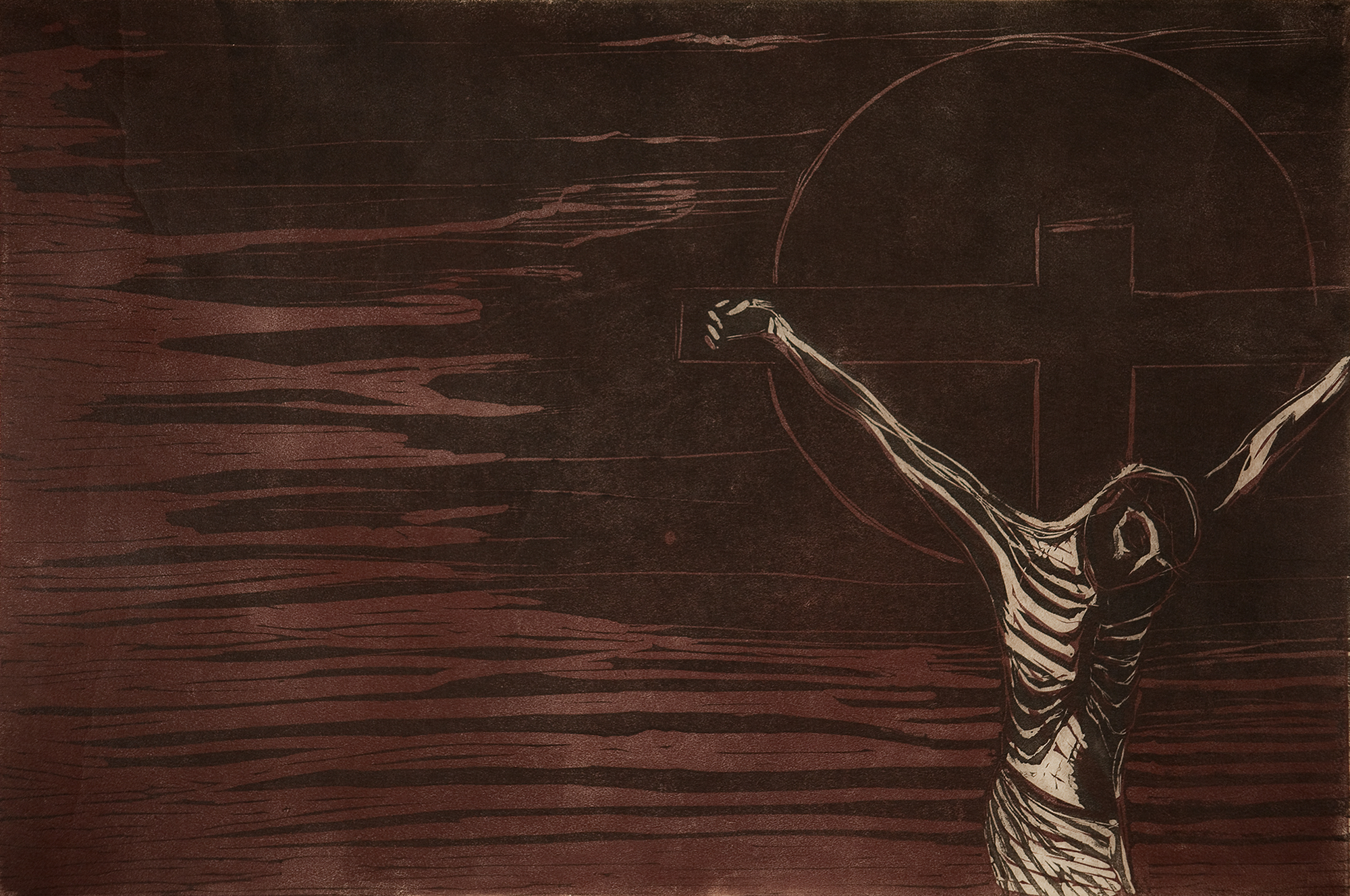
[the twelfth station: Jesus Dies on the Cross]

GorossStnCross13

[the thirteenth station: Jesus is Taken Down from the Cross]

GorossStnCross14

[the fourteenth station: Jesus is Laid in the Tomb]

GorossStnCross15

[the Resurrection of Jesus Christ, the Lord, on Easter Sunday]

Movies for an Intense Lent

*updated March 22, 2017* Lent is a long season. And to help me get in the mood of reflecting deeply on my faith, and contemplating deeply about Jesus Christ’s Passion, I have five movies I can turn to (or check my list of music for an intense Lent). But be warned. These films are intense and will not slip from your memory any time soon. The struggles, challenges, drama and suspense lingers… lingers…

SisterLuke——First up: The Nun’s Story, starring none other than the exquisite and stunning Audrey Hepburn as Sister Luke. In this film, we see a young and beautiful woman discern the religious life, but all the while, we see something not quite right. Did she enter for love of Jesus? For love of the Church? Or was the sisterhood merely a tool for her? When I first saw this film, I could not believe what I was seeing. As an Audrey Hepburn fan, as someone who was open to discerning the priesthood, and as a fan of film, this movie was a major treat and surprise. Click here for the whole film (while the link remains active).

——Second: The Passion of Joan of Arc. This is a silent film with a haunting score, a haunted past, and a haunting recovery. The real life struggle to get this movie on screen is already harrowing enough to make one think the devil tried to keep this where the sun don’t shine, but today, it is considered one of the top ten films ever. Don’t let its age, its novelty and its daring discourage you from viewing this movie. Search for it at your library, or online. There are at least three versions now. I only recommend the one accompanied by Richard Einhorn’s Voices of Light score (click link to listen!).PassionOfJoan

——Third: Noah. A movie misunderstood by many to be Christian, but it’s actually a Jewish film that stretches the story of the Great Flood in ways that kept me at the edge of my seat. I was stunned to see how riveting the story was, how terrifying such a flood must have been. And since I wrote extensively on this film already, please click here for my review and for the thoughts of others more learned than I.

——Fourth: The Flowers of War. Though the movie is about the 1937 December invasion and Rape of Nanking by the Japanese army, its portrayal of utter human suffering and redemption is perfect for Lent. The movie stars Batman: aka, Christian Bale, and is directed by Zhang Yimou (Hero, House of Flying Daggers, 2008 Beijing Olympics Opening Ceremony). In this epic, Bale finds himself having to play the role of a Catholic priest to protect 12 abandoned school girls trapped and stored in the Cathedral by the Japanese for future use. This film is so intense that I cannot recommend it for family viewing whatsoever. Be advised.

——Fifth: The Prince of Egypt. The origins of Passover are essential to grasping the weight of the Paschal Mystery. Though seen as a children’s film, this movie is definitely for adults, too. Do not miss this [musical] depiction of the Exodus story. Although there are certain creative licenses taken that deviate from the Scriptural telling, the film is a great expression of the desperation of the Hebrews and the overwhelming glory of God’s presence and power. Need more convincing? Have a watch of one of the best scenes: THE PLAGUES

——Finally: The Passion of the Christ. I save this one for Good Friday, and for good reason. And unlike many, I don’t shed a tear at all… until Mary meets her Son on the road to Calvary. I love Jesus. I believe He is God. And God can take care of Himself. But when Mary appears, her broken heart cuts me down. Gets me every time…

——BONUS: this film The Road is also very intense and not to be viewed lightly by families and children. The story is a man trying to care for his son in a post-apocalyptic world that is two-thirds the way to hell. The sacrifices, struggles and sheer terror of what this world is reminds me of what sin did to us, and what sin still does to us when we let it reign. Give this a watch if that sounds like something that will help you stop taking sin lightly, and stop taking life for granted.

——AND A DOCUMENTARY: History Channel produced this detailed and fair research on the mysterious Shroud of Turin (the most studied human artifact, ever). This cloth is believed by many, scientists and faithful alike, to be the original burial linen of Jesus Christ. It is also believed to have been physically affected by the Lord’s  resurrection, affected in a way that science has been unable to explain, to date. Give The Real Face of Jesus a watch (but beware of the heretical and nonsense gnostic material inserted awkwardly (and unnecessarily) in the middle of the documentary). More documentaries researching and studying the Shroud here.

Lesson Resources from ALL TNTT Training Camps

Hello beloved HT of TNTT (and any possible eavesdroppers),

This post refers to the various training camps I’ve visited since 2013. (Lincoln, NE; Stockton, IL; Miami, FL; Epworth, IA; Buffalo, NY). If you were at any of the Sa Mạc lessons that I had the honor of presenting, here are the extra resources and information just for you, as mentioned and promised:

—–1) Marian Devotion Workshop:assumptionweb1

  1. You can find the text of my testimonial about meeting Mary here, and the worksheet here.
  2. Rosary Comic Book: great for all ages. If you haven’t seen it or prayed with it, you must check it out. My favorites are Gene Yang’s depiction of Mary’s Assumption and Coronation. (As of today, the book seems to be hard to stock… so get yours now!)
  3. When I was at my 8-Day Silent Retreat, I picked up The World’s First Love and fell in love with our Lady. You might, too!
  4. The ancient Latin hymn I may have chanted to the Queen is known as the Salve Regina

—–2) Adoration & Benediction Workshops:

  1. In the silence of the heart, You Speak (and when God speaks, we listen!) [and this is my official movements to the song!] Remember to use this only before Jesus is exposed, or before you enter His presence in the monstrance.
  2. The official Holy Hour Guide from the Institute of Priestly Formation! Seriously, I found this very helpful for getting the most out of my Holy Hours with the Lord. I used this multiple times during during multi-day silent retreats.
  3. Detailed rubrics for proper Benediction and Adoration protocol (please follow this in detail to prevent sacrilege).
  4. Handy brochure to print and share with adorers during Adoration (semi-Việt version here). If you want a customizable version for you to tweak, please email me at EvanPham@HolySmack.com
  5. Document on how to prep adoration for Knights of the Eucharist (HS), how to prep for Companions (NS), for Seekers (TN), and for Seedlings (AN).


—–3) Living a Eucharistic Day Workshop: Handy brochure to encourage and guide your Eucharistic Day (Sống Ngày Thánh Thể)

  1. Also check out this post: You Are What You Eat (remember my example with strawberries?)

—–4) Sharing Sacred Scripture Workshops:

Handouts to prepare for: Seedlings (AN), Seekers (TN), Companions (NS), and Knights (HS)

  1. The 2nd Edition Revised Standard Version – Catholic Edition (RSV-CE). I love this Bible… the leather bound and hardcover versions are bomb.
  2. Study Bible of the 2nd Ed. RSV-CE, aka: the Ignatius Study Bible. For now, only the New Testament is available in one volume. The Old Testament is being put together right now, and so is only available in individual issues (I have the Genesis issue, which is amazing… I used it to create HTDT based on the whole Torah/Pentateuch). Dr. Scott Hahn is one of the faithful minds behind this study Bible.256x256bb
  3. Free app to read the whole Bible with interactive and in-depth commentary from the Church Fathers. Don’t miss out on this neat tool, called Catena.
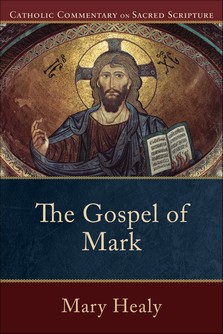
  4. Catholic Commentary on Sacred Scripture: this series on the New Testament is indispensable for anyone who wants to know the way the Church reads the Word of God. I highly recommend starting with the Gospels (my seminary’s Scripture classes use this series).mark_small
  5. Pocket Guide to the Bible: great introduction to what the Bible is, its history, how to use and read it, and how it’s organized.
  6. Where We Got the Bible: something I read to learn how the Bible came into existence, and how the Catholic Church assembled it and maintained it throughout the ages. Pretty fascinating, considering the Bible is the Church’s book.
  7. If you really wanna get into more Scripture treasures, then read anything by Dr. Scott Hahn and listen to his talks on YouTube. He’s a great speaker to start with. A Father Who Keeps His Promises is a great treat for us who want to know the main theme of the Bible.
  8. Great Adventure Bible Timeline of Salvation History: we all prefer a slick timeline chart instead of a chunk of words, so this is a great visual aid to exploring how the Jews, Jesus and His Church all fit together.
  9. And most importantly, an online Bible in Greek, Latin and English, if you’re down with exploring the Scriptures in the ancient Biblical languages (I haven’t found one for the Hebrew, yet).
  10. The BibleSmack Game (yep, I finally found a good name for it!). Here are BibleSmack‘s rules and files you need to play this game with others:


BibleSmackNewTestament Cards

BibleSmackOldTestament Cards


—–5) Theology of the Body and Christian Morality: see my ToB collection here.


Remember to send me any questions you may have; you’re always welcome!

← Back

Thank you for your response. ✨

TNTTLogo