
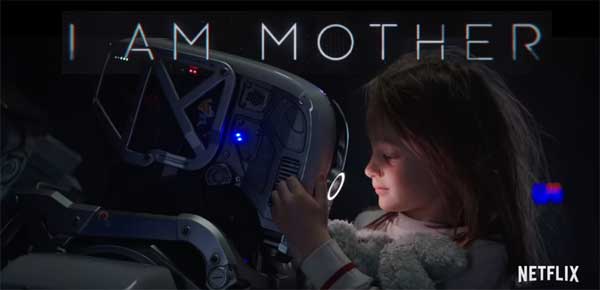
So Netflix was threatening to boycott the State of Georgia for its pro-life laws. Netflix is worried that Georgia will abort abortion. Because of this boycott threat, many pro-lifers are boycotting Netflix.
But Netflix is a hypocrite. It’s not really serious about abortion rights. Because if it were, it wouldn’t be streaming pro-life movies like I Am Mother. That’s right, Netflix actually streams a very pro-life, very anti-abortion movie. If Netflix doesn’t realize its contradictory stance, then it’s either simply hypocritical, or incredibly ignorant of its own content, or it’s secretly anti-abortion. I’m not sure what they are, but here are the pro-life signs from their recent critically acclaimed hit film itself:
—
—
—
—SPOILER ALERT—
—
—
—
- The film presents a feminine-voiced robot as a mechanical mother tasked with raising a baby girl. In fact, every mother figure in this film is female/feminine. In our LGBTQRSTUV+ conscious culture, why is the mother presented as womanly and feminine? Why do advanced, super artificial-intelligence robots of the future use old-fashioned traditional family roles in its attempt to raise the perfect human? Hint: because that’s how humans are meant to be best nurtured.
- There’s no mistake that motherhood is the theme of the film (the title?). But notice the plot twist: Mother-Bot has been long terminating human girls when they failed to qualify for continued existence. Mother-Bot administers tests on her daughters, and only raises the current protagonist because she has been passing. When we find that other girls had been gestated, born, raised, tested, failed, and then incinerated, we sense the film wants us to feel horrified. The fact that we don’t know how many girls have been burned to bones alludes even more to the fact that we may perhaps never know how many girls have been aborted in our world (in China alone, its missing an estimated 30-50 million girls. Talk about an actual war-on-women).
- But back to the film: so what if Mother-Bot terminated some girls during gestation? So what if Mother-Bot discovered a mutation, or a disease, or some other condition the unborn baby had, and then deemed her unqualified for the perfect life (whatever perfect even means)? What difference is there between terminating the girl then or terminating later? The motive is the same: the girl is not good enough.
- Here we see a commentary on the rampant objectification of girls and women in our culture. If she isn’t beautiful enough, hot enough, smart enough, small enough, skinny enough, et cetera enough, then she’s not worth it. If she doesn’t make me happy enough, proud enough, successful enough, then she’s something I must destroy. I decide if her life is worth the work I need to put in. –Mother-Bot

- But why does the film try to make us sense this mentality is horrific? If abortion is a woman’s right (as Netflix claims), then why is Mother-Bot not just an everyday hero doing what every mother should be free to do? Sure, you can say it’s because the baby isn’t actually inside Mother-Bot, but Mother-Bot even says in the film that she is more than just one robot, she is all of them, and the entire gestation/nursery facility, by extension. She runs everything, so actually Daughter is very much inside Mother-Bot, using her resources, time, energy, and space. And that relates very much to the argument for abortion-after-birth that is getting popular among many politicians of a certain political party: John Rogers (AL), Governor Northam (VA), Del. Tran (VA). After all, born babies keep using their mother’s resources, time, energy, and space… for years and decades.
- So point made: real motherhood is not about killing one’s children. We see this argued for by Daughter when she is upset about her culled siblings. If termination wasn’t bad, why all the outrage and fear from Daughter? Remember, Daughter is human: she is the protagonist who represents us in the film, as fellow humans who are pro-life/dignity/children/parenthood. Mother is the cold, mechanical, utilitarian, false-motherhood antagonist who is pro-choice/abortion. The choice is easy: be like Daughter!
- If that’s not enough signs of the film’s pro-life message, consider how the myriad fetuses are addressed: they’re called brothers and sisters. Including the unborn embryos! Their not called “clumps of cells”, or “potential people”, or merely “products of conception”. They are already family members.

- Additionally, quite a few Catholic symbols appeared both prominently and subtly in I Am Mother. Obviously, the rosary (as our Blessed Mother’s prayer), and the Marian icons (in the shipping container where the woman lived), but also that Daughter becomes the mother-figure for her newborn brother. Daughter, in a sense, is the virgin mother of the baby boy. For any astute Catholic, that’s an obvious reference to the only real-life Virgin Mother. Sadly, where the film is going with all this religious motherhood imagery is still lost on me, so if you have any insights, I’d be glad to hear it.
- On a related note, there’s also the issue of manufacturing children and growing them in gestation machines (as opposed to to conceiving children and carrying them in their mothers’ wombs). I’ve been mulling on writing something about this topic for a while, so this is a sign for me to get it out. But before it gets written, please see #3-4 above for arguments closely relevant, and also my philosophy thesis discussing the humanity and absurd predicament of frozen embryonic children.
So there we have it. Signs strongly suggesting that Netflix is flip-floppy about its abortion advocacy. Sure, boycott a pro-life state, but don’t boycott a pro-life movie streaming from your own collection? Come on. Just come out and say it: Netflix is secretly anti-abortion (or at least conflicted).
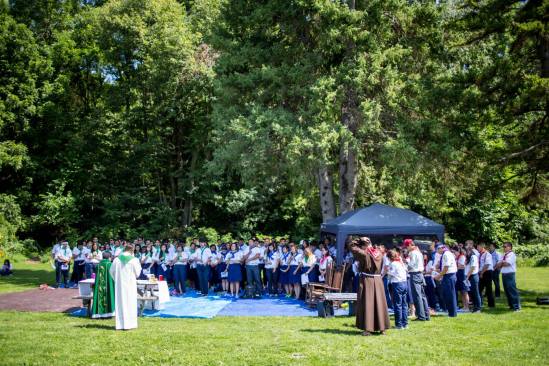 I was at the Midwest’s annual weekend training camp for leadership in the
 ![[Korean Figure Skater, Yuna Kim, wears the veil.]](https://holysmack.com/wp-content/uploads/2014/08/yuna-kim-veil.jpg?w=210)

 When I read Crystalina’s thoughts on the mantilla, the idea of wearing one intrigued me, but I brushed it off because I didn’t want people looking at me funny or thinking I was getting above myself. But the image of the veil kept popping into my head, incessantly and constantly. I decided to pray about it and leave it up to God to show me what I should do, because if I was going to go all out Mary-style, I needed to know exactly why I would. In the meantime I did some research on it. I found that several First Ladies, including Jackie Kennedy, Nancy Reagan, and Michelle Obama, all wore veils upon meeting Popes John Paul II, Benedict XVI, and Francis. If powerful women felt the need to veil themselves in the presence of the Holy See, why shouldn’t we veil ourselves in the presence of Jesus in the Eucharist? Not only does the veil show that women are sacred, it also helps you grow into your sacredness. The wearing of the mantilla promotes the growth of virtues such as chastity, purity, humility, and modesty, all of which are exemplified in the Virgin Mary, who is always depicted wearing a veil.
![[Icon by Mina Anton]](https://holysmack.com/wp-content/uploads/2014/08/maryjesus.jpg?w=212)

 —Evan: It actually came a bit from personal experience. I remember being on my feet all day, heels aching, toes all stiff, and then stepping into soft cool earth. It was amazing how good it felt, especially since it was summer and everything was so superheated. It was like a massage just standing in the soil… similar to digging your foot deep into a beach volleyball court, deep where the sand is cool.
 Yet again, she just ran all that way home from wherever she was before, some sort of laboratory or hospital. And the setting she’s in now, rice paddies and dirt roads, tells me she’s nowhere near the city.
 —Evan: Not to mention I just realized that “nettle” sounds awfully like “needle” too… wow.
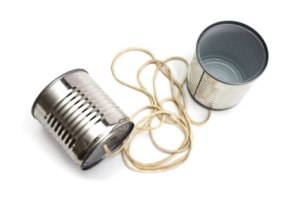 The phone is just a medium, a conduit, a fancy pair of cups tied together with string. Now that we have smartphones and video chat, the analogy gets even better: we’re human persons. Humans have ears and eyes, skin, nose and tongue – we can sense: hear, see, touch, smell and taste. And we need to. As Christians, we believe God made us and that He knows what He’s doing, that He made the physical body a good thing, and that humans need their body to be human!
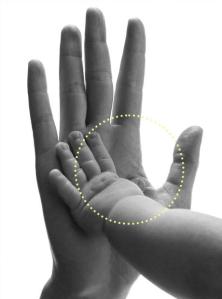 So when we pray, we not only use our mind, voice and hearing, we want to use our sight and touch. We want to have beautiful eyes to gaze into, patient ears to whisper to, and open hands to hold. A statue serves that purpose. Of course, we would much rather have the person physically there with us, but it’s not always possible. Think of the times a mother remembers and thinks of her child when she folds their clothes, or when a father thinks of his child when he looks at an old photograph – that’s exactly what Catholic statues, icons and relics help us do. We don’t worship or love the object, but we use the object to remind us, to connect us with the beloved. The objects help engage more of us, not just engage our mind but also involve our bodies. As fallen humans, we need all the help we can get when we pray.
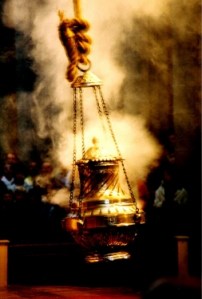 —You: Wow, that makes sense… it reminds me of the phrase “smells and bells” when people think of the Catholic Mass. The priest uses incense and there are bells being rung at important moments. So, even our sense of smell is brought into use in prayer!
 —Evan: Ah… that’s one of the titles (like a nickname) for Saint Joseph: also known as San Jose in Spanish! That’s right… the city in California is named after him. We call him Mary’s Most Chaste Spouse because he loved his wife (Mary) with a superhuman and chaste love, a love that was lustless and self-sacrificing. I understood this nickname of his even better when I heard one of his other titles: St. Joseph, the Terror of Demons. Yep… he terrorizes demons. They loathe him, avoid him, and fear his holiness. Because he refused to lust after Mary, the devil couldn’t bait him. Most of us, men especially, fall into lust because we don’t have the strength or know what true love is. True love is always chaste: honest, sincere, unselfish and faithful. Think about this…
 Holy Smack