The Confessions of the Joker

Confession2

That’s right… even the Joker is serious about the Sacrament of Confession and Reconciliation! Have a listen to his conversion story!

Here’s the transcript:

Hi…

Most of you know me as the Joker. When Evan heard about my conversion, he contacted me and asked I could share my experience on Holy Smack. I said, I’d love to, but only if I could say whatever I wanted. He said okay. So here goes…

Last time you saw me, I wasn’t in a really good mood.
I killed people.
For fun.
I almost destroyed Gotham.
For fun.
And I tore down Gotham’s White Knight.
But her Dark Knight… oh, that Bat Man flipped my life around.
You see, while I was in prison, I was kept in isolation, and for good reason. I was insane.
And I never had any visitors. Except for one man.
He was a Catholic priest.
And he told me something I’ll never forget. In fact, I’m gonna tell you what he said, and I hope you’ll never forget it either:

You see, in confession, all your sins just… disappear.
You go into the confessional, and there’s the priest. Just sittin there. You can be anonymous to him, and he doesn’t care. You can tell him anything, even everything, and he doesn’t care. You think you’re sins are special? Original? Yeah… right… there was only one original sin, and Adam and Eve beat you to it long time ago…

Anyway, the priest can’t tell other people what you confess. What’s spoken in confession, really does stay ONLY in confession. He can’t tell your friends (if you have any), he can’t tell the police (yup, separation of Church and State at its best and original form), he can’t tell a recording device, he can’t tell another priest (not even the Pope!), and he can’t tell even your own sweet mother…

That’s called the seal of the confessional. And whatever you confess stays between you and Jesus. In fact, most priests even forget your sins as soon as you walk out the door. The Holy Spirit gives them a holy amnesia, otherwise, can you imagine living life knowing all the sleaze people do? It’d drive you crazy! Not to mention that confession can even get boring after you hear the same sin for the thousandth time… but don’t go out and try to impress a priest now! Trust me, that’s beside the point.

But in confession, you’re in hand to hand combat with the devil. Satan is a fiend. Worse than what I ever was. And he doesn’t want you there. He doesn’t want you anywhere near confession, because in confession, you’re really near the Lord. Confession is actually more powerful than exorcism! And in confession, you’re humbling yourself, and the devil is one prideful, stuck up jerk. And in confession, he’s hiding in the shadows of your past.

And the closer you get to Jesus, digging up your history of sins (and it might me from 5 years back, 20 years back, or maybe even just 20 minutes back), the stronger the light breaks in. Oh man… that light burns, like 10,000 UVA and UVB. And it obliterates the shadows. That’s when you can see the worst sins trying to get away from confession — they want to hide from being exposed. They first try to convince you that they’re no big deal, small fry, no more sins here, just move on. But keep going after them, and they get nasty. Then they try to convince you they’re too big for forgiveness, way too big to be rid of, way too much and you can’t handle it… you’ll be so embarassed by them.

Don’t listen to those lies. In fact, that’s when you know for sure this festering thing has to be purged. So grab it, and it’s black greasy tentacles will freak out. Like some leprous octopus. So drag it out into the light, spit it out in confession, and it’ll scream: “Let me go! Jesus can’t forgive you! You’re disgusting! Leave me alone!”

But that’s it’s last words. Because Lumen Christi — the light of Christ, that’s right, I know my Latin — His light sears and cuts that demon down, and it fizzles off like a fart in the wind. Nothing left. Just… gone.

That’s the power of the priest’s absolution: Christ working through the obedient and docile man, so he can pluck off and chop up the leeches that sucked on your soul. If you need to know how ugly sin is, just look up images of leeches and lampreys and pelican eels, and remember that sin is even uglier.

And now, why am I telling you this? Well because it worked for me.

I went to confession. And I confessed a sin that was festering in me since I was a little 10 year old boy. No matter how much a tried to stop, I just couldn’t keep clean. It haunted me, perverted me, and I lost control of my childhood. I was addicted; I became evil. But I didn’t want to stay this way.

So thank God. Because after that confession, that sin no longer had any control over me, and today, I’m free. Even in prison, my soul is free. I feel stronger and better today than I can ever remember!

And if it can work for me, it can work for you.

Now, all I need to do is try and talk like a normal person again… baby steps… baby steps…

God love you.

Interpreting Interstellar

InterstellarA dozen of us from the seminary just experienced in IMAX Christopher Nolan’s latest film: Interstellar. There was so much nourishment in the film to milk, that I’m going to have to return for seconds during Thanksgiving break, but for now, here is what left me most satisfied (and no, it’s not just the Buddy’s Pizza we just inhaled):


—SPOILER ALERT—


—–1) About halfway through the film, the astronauts come to a fork in their journey and have to decide definitively which planet to visit. They appear to have two solid options, but Anne Hathaway’s character – Amelia Brand – chooses illogically and with great bias. The other two crew ask her why, since their choice is more reasonable and has better chances. Her answer made the audience laugh, me included. But then Ameila explained, and I caught myself falling in love with her answer. It resonated with me. I myself thought about it for a long time: Why does love exist? What is the reason for love?

Answer: there is no reason for love, because Love IS the reason.

Here’s what Amelia said, roughly paraphrasing: I choose this planet, and not the one you have decided on, because somewhere on this planet is the man I love. I cannot explain why, but I know my heart, and I’m trying to follow it. It doesn’t make sense, but that’s because love transcends what we can sense, what we can measure and quantify and experiment on. Love cuts through time and space, because even though I haven’t seen Edmund (her lover) for years, I still love him and am drawn to him. Even though I have every reason to think he is dead, I need to be with him, to know for sure. There’s no reason any of us should keep loving people who are gone, who are far off, who we may never see again, but we still love, because love is the only thing the universe cannot explain.

And the reason why the audience laughed was because we thought she was going to be all mushy and sentimental about her choice: Oh, here we go again… all this follow-your-heart and lovey-dovey stuff… bah humbug!

BUT that’s where Philosophy and Theology kick in: it is true that love transcends the world, the universe. It is completely beyond what is necessary for the universe to keep going, and also completely unnecessary. Love, in short, is supernatural; it’s above nature, not found in nature, and does not naturally occur. Animals, plants, and atoms do fine without it. Love can even put us at risk of danger. Nature would be fine (maybe even better) if love didn’t exist, except that it does exist. And if this supernatural thing we call love actually exists, that means there’s a whole bunch of stuff out there that is beyond our science (“stuff” like God, the Divinity, the Creator). The film even lays it out: “Science is about admitting that we know so little.”
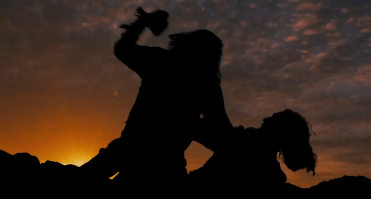
 

CainAbel

[Cain murders his brother, Abel. This screenshot is from Darren Aronofsky’s “Noah”.]


—–2) When the remaining crew land on a planet and revive Mann, a huge twist in the story comes up and reminds us of Cain and Abel. The parallels are unmistakable: Mann is Cain, and both are the elder character (Mann was on the planet first and for a longer time). Cooper is Abel, both were the younger character (Cooper arrived later on the planet). Mann tells Cooper (Cain tells Abel) to go out into the field (the wilderness) with him, and that’s when the elder rises up against his brother out of selfishness and seeks to murder him (see how similar it all is to Genesis 3).

Right away, goosebumps filled my epidermis: here they were, in a new world, ready to begin another civilization, and here was the original sin, back with vengeance. Our fallen nature as sinners goes with us wherever we go, even to Saturn, even through a wormhole into another galaxy, even to the edge of a gargantuan blackhole. We cannot rise above without help from outside the human race. Our world/s will be tainted, like the cursed Midas Touch.

Coincidentally (but probably not), the film’s mighty organ music pipes up during this scene (track “Day One Dark“). Given that the organ is rarely featured in film scores, and the prominence the organ has in this very Biblical scene, one has to wonder what Mr. Hans Zimmer was implying by using this instrument that was adopted specifically for the Traditional Latin Mass of the Catholic Church. [Update: click here for all about the selection of the organ for the score!]
—–3) Jessica Chastain’s character – Murph – goes behind her big brother’s back and undermines him and his [insane] will for his family’s future. The tension builds as he returns to discover his sister’s cunning, and just when we think he is going to do something terrible to everyone, Murph runs out to him, smiling, gushing with hope and love, and she embraces him. Immediately, I knew the phenomenon. I experienced is many times and have dubbed it “Severe Tenderness”. It goes something like this: A few years ago, I was at work one day at the sushi restaurant. My shift on Friday evening was the forbidden hour. I was regularly alone at the front during the dinner rush (4-6pm), taking orders, running orders, preparing dishes, washing dishes, cleaning tables, etc. I learned how to work without thinking, to grow four extra arms, and to lose my temper. But always at 6pm, backup would arrive and pitch in. This woman only worked for two hours (6-8pm), but when she would arrive, I was ready to dump all my frustration out on her. Except, when she came up to me, said hello, asked how I was, and so ready to help me… my anger, stress, and tantrum melted away.

Her smile and sweetness was tender enough to soothe me, yet severe and powerful enough to cut through all the mess that was attacking me. It was instantaneous, and instead of blowing up in her face, I smiled back and worked even harder to help her have an easier evening at work. She became someone for me to serve, and I loved it.

Severe tenderness is a gift, a strength not everyone has, and even in my life there are only a handful of people who have that effect on me, consistently. But don’t go and try to see if you’re one of them, okay?

—–4) At the epic’s end, we find Cooper being sent on a mission: somewhere out there in the new world (new planet) is a new Eve (Amelia). It is not good for her to be alone. Go find her. She’s waiting for you. Be her new Adam. (Yes, strongly echoing Genesis again!) [This also strongly hints how Mary (the true New Eve) comes first and awaits the coming of Jesus Christ (the True New Adam!).]

And when Murph tells Cooper of this, reminds him about Amelia, his love for Amelia is roused. This reminds me strongly of the love story found in the Book of Tobit: the love of Tobias and Sarah. You’ll have to find it in the Bible yourself, read it and watch Interstellar to understand what I am saying. But trust me. It looks pretty parallel to me.

CryoEmbryo—–5) Lastly, Interstellar mentions cryogenic-embryos as part of the backup plan to ensure mankind’s survival. I’d like to point out that the film eventually determines this option to be inadequate, because it means giving up on saving those who are alive. This is not the only reason why cryostorage (super freezing) of human embryos is morally evil, mainly because human persons deserve better than to be left vulnerable in canisters and left there as a resource to tap, manipulate and own. I won’t go any deeper on this point for now, because my philosophy thesis is on this issue, and when it is finished, I’ll be sharing it then. This review is already lengthy enough.

—–BONUS) The biggest plot hole in Interstellar is actually a powerful sign of a something more. Philosophy labels this “plot hole” in reality the Infinite Regress. This is a bit difficult to follow, but hear me out:

      At the film’s end, we discover that:
a) Cooper goes back in time to tell his past self (call this Cooper2) about the secret NASA coordinates.
b) Cooper2 gets the message and goes to the NASA coordinates, and begins his journey.
c) Cooper2’s journey leads him to the blackhole, where he finds a way back in time to tell his past self (call this Cooper3) about the secret NASA coordinates.
d) Cooper3 gets the message and goes to the NASA coordinates, and begins his journey.
e) Cooper3’s journey leads him to the blackhole, where he finds a way back in time to tell his past self (call this Cooper4) about the secret NASA coordinates.
f) Cooper4 gets the message and goes to the NASA coordinates, and begins his journey.
g) Cooper4’s journey leads him to the blackhole, where he finds a way back in time to tell his past self (call this Cooper5) about the secret NASA coordinates…
ETC. ETC. ETC. for infinity…

But, who told the first Cooper [about NASA] in this infinite chain that goes nowhere and leads nowhere? Was it another Cooper? In that case, who told that other Cooper? And who told that Cooper? And that Cooper? And that Cooper? Etc. How do we even know that this chain of events can change?

This unsatisfying answer/explanation is actually a way to dodge the question, because it gives you no knowledge of anything. This is the INFINITE REGRESS, and it shows that we have to find the first person who started off everything, aka: the first causer, the one who is outside of the chain, outside of our universe, outside of Creation, outside of our reality, outside of the Big Bang, the one who started it off and set things in motion. Philosophy (and St. Thomas Aquinas) calls this first cause by the name God. Theology calls Him Father.

For those of you who want to give Philosophy a go, here’s an excerpt from page 217 of the text (The One and the Many) we’ve been studying in class at seminary (to further flesh out this concept):

[from W. Norris Clarke's "The One and the Many"]

[from W. Norris Clarke’s “The One and the Many“]

All in all, despite some shortcomings in the film, the good points far outweigh the bad. I was very impressed, and was left breathless at all the science, philosophy, subtle theology, love and sacrifice blended together in harmony. I loved being tested on how much I knew and if I could follow along, instead of being spoonfed (like how most of Hollywood does). Thank you, Lord, for storytellers like Christopher Nolan and Co., and thank you for creating us with the wits to enjoy such stories. Amen!

BlackHole

Just viewed Interstellar again (Nov. 29th, 2014) and had a few more sweets to share with y’all!

—–6) We find out about the MONSTROUS LIE, the temptation Mr. Doctor Brand (Michael Caine) used to bait Amelia and Cooper on the mission. This scene became clearly alluding to the Original Temptation in Eden, when the serpent lies a monstrous lie to Eve, and Eve’s fall brings down Adam (arguably because Adam did not rise up and smash the deceiver instead!). In this film, we see the same thing play out, and the lie, no matter how good it sounds (because nobody wants something evil, but we all want things we may think are good), is always deeply hurtful to the relationships involved.

—–7) Plan-A, or Plan-B? One of the main objections to Plan-B in the film (and rightly so) is because it gives up on those on Earth. It condemns the living to death, labels them hopeless, and then dismisses them. This reminds me of the Pro-Abortion mentality: a woman becomes pregnant, and since she cannot raise a child because of poverty,diseases, etc., she and others are pressured to abort the baby. The baby is condemned to death and the mother is condemned to murder. The child is labeled hopeless and the mother is hopeless if she does not kill her child. The child is dismembered and dismissed as medical refuse, and the mother is dismissed, left to her own again, so that if she was in poverty then she remains so, or if she was abused and raped then she is vulnerable to being harmed again, or if she experiences post-abortive trauma then she is left to struggle with that alone. Plan-B is the first failure. And Plan-A is amazingly open to the genius of man and the providence of God.

—–8) St. John Paul’s Theology of the Body more than mentions the FEMININE GENIUS, and Interstellar is supersaturated with it. Throughout the film, we see a very strong showing of girls and women who know truths beyond science, beyond logic and beyond explanation. We understand this supersense that is peculiarly feminine as intuition, and we see this when Amelia schools us all about love and its transcendental nature, and we see this when Murph calls the ghost in her bookshelf a person, and we see this in how the love of father and daughter knows no bounds, and how Murph arrests her furious brother’s heart and wins him over (as discussed in #3 above). Just view the film with this Feminine Genius in mind, and you’ll see what beauty I mean.
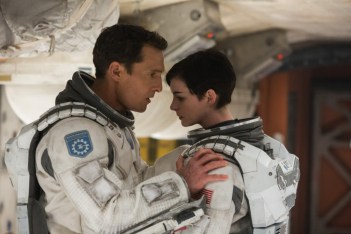
AP CLIMATE FLICKS A ENT FILE—–9) And the New Adam/New Eve typology (symbolism of Jesus and Mary) goes further still! When Cooper detaches from Amelia and the rest of the Endurance Space Station, he plummets into the black hole, sacrificing himself in order to let Amelia rise to safety and continue on to the new world.

Compare this with the Gospel: Jesus Christ surrenders Himself to the Crucifixion, sacrifices Himself and plummets into the place of the dead (aka: Hades). He is buried in the tomb, which is a black hole in the cave, in the ground. His sacrifice allows, actually it propels Mary (as New Eve and as the beginning and perfection of His Church) to rise and continue into a new world, a new redeemed Creation.

Lastly, recall that Amelia also believes Cooper to have perished in the black hole. She thinks herself alone now in the new world. But… Cooper is on his way to her, seemingly rising from the dead, out of the black hole and back to be with her. Now if this don’t sound like the Resurrection

—–And that’s all I got. For now… let’s see what a third viewing brings…

What Kind of God Do You Want?

Even if you don’t know if God exists, even if you don’t believe God exists, you can at least think about what kind of God you would like to exist, right? It’s like daydreaming: even though I’m no billionaire, I can at least fantasize about what kind of billionaire life I would like to live…

So play along and think about this: what kind of God would you want?

A powerful God? A God who is master of all?

Don’t misunderstand me, I do want God to be powerful and masterful. By definition, God is Power itself and Master itself. But think about it: if God was first merely Power, then what’s keeping Him from using that power to intimidate, to manipulate, to oppress and dominate us? Same with God if He was first merely our Master — what’s stopping Him from being a tyrant, a slave-driver, an abuser?

There are religions out there (I’m thinking specifically Islam) that believe God is Power and Master first, before He is anything else. But like we saw above, if God is first merely those things, or anything else along those lines, then what’s keeping Him from abusing His almighty authority, power, omniscience and etc.?

GodIsLove

Because God is first, before all else, a father… Our Father.

Not the kind of father you and I have, because human fathers, earthly fathers can make mistakes, can be selfish, can be ignorant and even evil. But the Father in Heaven — the Father who all other lower fathers are meant to imitate and symbolize — is Love. Our Father is Love.

And as Father, as Love, God will not abuse his authority, not enslave us nor intimidate nor manipulate us. As loving Father, He will not use omniscience, wisdom, or anything to hurt us. Instead, He will use all that He is to love us and help us…

He even sent His Son to be a man and die for us.

So I don’t know about you, but I’d want a God who is Father, who is Love. And I’m grateful this God is ours — the one and only.

For more, check out Dr. Scott Hahn’s excellent discussion on who God is to us:

Blasphemy with Breakfast

Abba or Allah?

Slaves and Sons

Modesty at Mass

Recently I received a thoughtful question from up the TNTT vine…

“If the Theology of the Body teaches that our bodies are beautiful and reflect God, why must we be modest in Church?”

audrey_hepburn_type_1

[Audrey Hepburn’s quote illustrated by Alicia Vasquez.]

Modesty is not about covering up something because it is ugly. Instead, it’s about cherishing and protecting the beautiful, especially about safeguarding love and respect. Since Woman (and all things women) is the more beautiful sex, there is an emphasis to safeguard her. Women do this by dressing and behaving appropriately to help others see that there is more beauty to them than just their skin and hair (because it’s so easy to stop just there).

Since women are so attractive, it is easy for men to get caught up in the physical and external looks. By dressing and behaving modestly, they are helping others find where their true beauty is. I like to remind myself with this quote: “The most beautiful part of a woman is her.” Meaning ALL OF HER. The moment we focus on just one aspect of her person, is the moment we objectify her and abuse her. Her whole person (body, soul, mind and heart) is beautiful, and modesty helps us find that total beauty by guiding our attention to her as a person instead of getting caught up in and stopping at the external beauty. Modesty helps us treat others and ourselves with the dignity and respect we all deserve. Modesty done right, it makes us free and happy!

At Mass, we also dress modestly* to help others find where the true beauty is… where Beauty Himself is: Jesus (God). After all, God invented beauty itself! He is Beauty itself! And everything that is beautiful is only beautiful because He knows how to make it that way. So if we behaved and dressed immodestly, we are not just disrespecting ourselves, but God (because we’re distracting others from realizing where Beauty is).

Here are two posts I wrote before addressing this question:

Even the Blind See Her Beauty

How Women in Veils Inspire Males Like Me.

I hope that helps!

*Note: dressing modestly does not mean making yourself look ugly! It means having good taste, class and dignity. For tips about this, I recommend these:

1) Verily Magazine (yes, I do read this once in a while and not ashamed about it!)

2) Leah Darrow (once competed on America’s Next Top Model)

3) And a whole bunch of short articles about Modesty from ChastityProject.com (by Crystallina and Jason Evert)

Lego Movie Theology

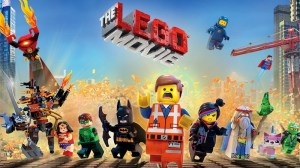
LegoMovieWhen I first saw the trailer for The Lego Movie, I thought: “Dude, who wants to watch Legos when you can play with Legos?” But now I realize: why not do both?

So after reading the ever trusty [soon to be Deacon] Steven Greydanus’ review, I finally had the chance to see the film for myself and I noticed a few things…


—SPOILER ALERT—


—–1) The movie revolves around a tyrannical perfectionist who tries to brainwash, dominate and freeze the Lego-world into what he thinks is the perfect Lego world and society. Opposite this obsessed character is a resistance group trying to inspire people to be creative, to think for themselves and use their free will.

SheenTIMERight away, this reminded me of Venerable Archbishop Fulton J. Sheen’s talk on a Perfect World versus a Moral World: essentially, what kind of world did God create… a perfect one? or a moral one? and why?

Well, we all know the world today is far from perfect. Even in the beginning, when Adam and Eve sinned, we became imperfect. In fact, even before our beginning, one-third of the angels sinned and fell from Heaven! So… if even 33.33333333 percent of the angels crashed, what in the cosmos was Almighty God thinking when He made everything?
Again, we can see here that God had two choices: make a perfect world, or make a moral world (not quite the opposite of perfect). And obviously he chose a moral world. That leaves us to ponder: WHY?????!!

Because a perfect world would mean he is a puppetmaster, an overlord, a slavedriver, a Matrix. He would call all the shots, make all the moves, think all the thoughts, and do all things done. There would be no possibility for anyone else to have freewill, self-determination, self-mastery, etc., etc…. including LOVE.

That’s right — if God created a perfect world, there would be no love, because we would all just be programmed to love, we would all merely love because we would be forced to. And if love is forced… guess what? it ain’t real. We need to be able to decide to love. If we cannot choose, we cannot love. This is why we inherently feel there’s something off about a 100% arranged marriage (some parts may be arranged, but to the point of forcing the man and woman to join against their will? that’s not gonna fly in the Faith.)
HelixNebulaSo God took the humongous risk: to create so that his children have free will. Free will for what? Free will to decide if they will love each other, to love Him back. If He forced them to love, that’s not good enough because it ain’t real. So He let us choose, and many choose not to love others, not to love Him… but those who do choose love, well then their love is true, real, free, total, faithful, and fruitful (or at least become that way eventually).

God made us with freedom not so that we can do whatever we want, but so that we can choose love. Love was worth it for God to forsake perfection. Love is always worth it for Him to forsake perfection. And if even He believes so, then we should also believe perfection is worth losing for the chance to love. And once you have real love, then the true creativity begins, because no one creates something to hate it, but to love it!

And last thing: God is the only person who can make something better than perfect… over and over, for forever. What was great, He can make even greater. What was super, He can maker superer (I know that ain’t real word), and yes… what we think is “perfect,” He can upgrade into eternity.

—–2) There’s a line in the film where Morgan Freeman says: “Sometimes you have to believe in order to see.”

Well, as awesome Freeman is, this line is not his. Saint Augustine already thought this thousands of years ago, and I just learned this a few months ago! A lot of people think we need to see something before we can believe it, like an “I’ll believe it when I see it!” kind of attitude… but actually, the reverse is more important!

If scientists didn’t believe in the logic of the scientific method, if they didn’t believe the laws of nature were consistent and non-contradictory, if they didn’t believe the facts and the data, then they would never see the truth. They would be closed to their own illusions, unable to see the intricacy and complexity of what they observe.

This also goes in our relationships: if we don’t believe our mother loves us, if we don’t believe our father protects us, if we don’t believe our siblings care for us, then we will always be suspicious of them, make up reasons to think they’re untrustworthy and lying, make up a fantasy that fits our disbelief.

Augustine and ChildThis is similar in our faith in God: if we don’t believe He is real, we will not know how to see Him. If we don’t believe he could be real, we will not know where to seek Him. If we don’t believe, we close our mind (and heart) to Him and will make up reasons that explain Him away instead of thinking more, meditating and contemplating into the deep.

And so, keeping an open mind involves leaving the window open, but also keeping the screen on… since there are always pests that want to sneak in and distract you.

—–3) Lego is successful because it teases our creativity. There’s a line that Saint John Paul II once said: “Man is, in a sense, condemned to create.”

When I first heard this, it hit me hard, because it’s so true. Our creativity is a powerful gift. We can create — like no other creature can! Our cities, stories, songs, sagas, civilizations… our arts, technology, cultures, societies… these are amazing things. Yet, at the same time… these can be a burden, a curse, a condemnation to us. How many times does an artist slave over her work? How many engineers become workaholics? Creating is laborious, tedious, and exhausting… yet our creativity drives us on (like right now… I should stop writing to get to my studies, but… just… one more… sentence!). Creativity is a mixed blessing, given to us by God. I only hope we use it for love and not evil.

LegoEnemy—–4) Finally, we see in the film an example of the best way to crush an enemy: by making him into a friend. After all, if you kill your opponent, he dies as your enemy, he dies in evil ways (assuming you are right and he is wrong) and you become his killer. But, if you can win him over, get him to understand and believe in your cause, then he becomes an ally, a friend, and the evil in him dies and leaves nothing left but love and friendship. The person is not the enemy, but it is the evil he thinks, believes and does that is the true enemy.

That’s all I got! I hope you enjoyed those insights! Thanks for reading. Now go play with some Legos!

“Heaven Is for Real” Made Me Cry… a little

Heaven is for RealBefore I begin, let me say first that I did not love this movie. It has great space for improvement (cinematic, theological and Scriptural), and I’m glad it didn’t cost me to watch it. Having said that, here’s a positive moment that I walked away with:

— SPOILER ALERT —

It takes quite a bit from a movie to make my eyes water. But, I’ve been noticing a winning recipe…

Mystery SisterIn Heaven is For Real, I was quite surprised they could dish it up. The scene that got me was when Colton tells his mom about his long-lost sister. When his mom asks how she looked like in Heaven, and what was her name, Colton says: “She looks like Cassie, but with your hair. And she doesn’t have a name. She said you never gave her one. She said she died in your tummy.”

This mystery sister was miscarried at such an early stage that her parents didn’t know her sex, and so left her unnamed. That part got me big. That this girl had no name. That even those who die before their birth deserve a name was evident in how brokenhearted Colton’s mother felt when she realized her little girl still went nameless.

And I hope you see how important this is. Everyone deserves a name, and God would actually give us such a privilege as to name our children for eternity. God does not directly name us… our parents do! And if we too become parents, then we name our children, and they will bear that name forever. That is the name other people will know them by, that is the name the angels will know them by… that is the name that God will know them by. Forever, into the ages of ages.

What kind of God do we have, who creates all and knows all, would allow us to name someone with a name that even He would have to use to address? He created this person! He loves this person more than any other can! And He let’s us name His beloved?!

I hope we don’t make light of this privilege.

P.s. If you didn’t notice, Adam was the first human, and he was also different from all the animals in many ways, including that he was given the privilege to go out and name everything else in creation.

[“Adam” by Theresa Dawn]

A Look-See at Lucy

Lucy-BannerWhen the first Lucy trailer hit my face, I was about to scream plagiarism!

On a warm autumn day in 2002, I daydreamed about a girl who had an accident that fully unleashed her mind. From then on, the scenes of how she would live played out in my imagination… and eventually give rise to the raw origins of my novel: Little Miss Lucifer.

I wasn’t worried though, and am not even threatened by Lucy. The story is way different. But even so, after spoiling it by reading the plot on Wikipedia, I still wanted to see what director Luc Besson could do with such a character. Here’s what I think of Lucy:

[SPOILER ALERT]

Saint Lucy1) First, the name of the film and Johansson’s character is — you guessed it — Lucy. But who was the person who popularized that name? Who is the person who every “Lucy” afterwards was named after? Well, like most names we have in English today, those names belonged to saints who launched them into popular use. Think of MaryAndrewJohn, and yep… Lucy.

Saint Lucy was a young Christian woman who was persecuted for her love of Jesus. One of the ways she was tortured before being martyred was that her eyes were ripped out from her face. Many icons of St. Lucy depict her holding her two eyeballs in a dish.

But here’s how this relates to the movie: In Latin, the “lu” in the name Lucy refers to “light,” as in “luminous” or “luster”. When St. Lucy was blinded and murdered, she no longer saw created light (the light of the sun, stars, firelies and lightning), but instead became able to see the true Light of the World: Jesus Christ, the God who created all other lights. (Btw, notice all the emphasis and focus on Lucy’s eyes in the film and its ads.)

In the film, Lucy also symbolizes this as someone who becomes able to see more than light. She can see, and sense, the world we know as mystery. She even explains that time is the standard of defining reality, not us humans and our standards, but time. Now, I don’t agree with this because even time itself can be destroyed (since spacetime is only a product of the Big Bang), and if time itself can be destroyed, then what? Instead, what I take from this is that we do not define what is real or true. Instead, the film tells us that reality and truth exist apart from what we think of it. In short, the film busts relativism (the idea that something is true only as long as we want it to be, and that we can all have our own truths about reality) into smithereens!

Creation of Adam2) Lucy in the movie also amasses huge amounts of information. She and others believe that knowledge is the purpose of life. She gains the ability to time-travel, manipulate matter, teleport, and even control other people. There’s criticism out there that the film’s use of Michelangelo’s Creation of Adam suggests that Lucy has become god. However, if this is the film’s intention, then it cancels itself out in a few ways. First, Lucy knows a lot about how and what things are, but she does not know why: as in why is there such a thing as the universe as opposed to nothing? Why is there life? Why does she exist? Why does she love her parents (their conversation was one of my favorites in the film)? Why is there love anyway? And what is love? Why are some things beautiful and others not? Why does beauty exist?Why does anything exist at all? Second, Lucy can do a lot, but she couldn’t even save her own body from decay. Unless there’s a sequel about her resurrection, she’s a pretty flimsy god. Third, she’s an even flimsier god since she needs a cell phone to tell her friend that she is everywhere (and more on this below). Fourth, is it really enough to know something, to know all things? If you had all the information in creation, but nobody ever existed to share it with, would that be enough for you? If you knew about love and what it was, but you were never loved by anyone, and had no one to love in return… would that be enough for you? What I’m saying is that knowledge is not the purpose of life… love is! And this reminds me of a quote from beloved Pope Benedict XVI: “For those who love, you can never have enough information” — meaning that a lover never tires of discovering and rediscovering  the beloved.

3) So, what’s up with Lucy needing to use the cell phone? In fact, what’s up with all these latest mind-movies (like Transcendence and Her) showing that untethered consciousness still needs a way to be physically expressive? Could it be because God (the real One) created us humans that way? That we need the physical to make ourselves known? That “the body alone, and only the body, can make visible the invisible” (I stole that quote from Pope John Paul II’s Theology of the Body). Think about it: if I had an idea, how would anyone know about it? Unless… I used my brain, nerves, eyes, hands, skin, bones, muscles, etc. to pick up a pen and write it out. Or used my vocal cords, lungs, breath, tongue and teeth to speak it out? We need our bodies, because we are our body. It’s not just something we have, it is us.

Lucy4) And back to the beauty question from #2 above: beauty is one of those realities that knowledge and information alone cannot explain. I mean, how do we recognize beauty? Why does it exist? Why is it important to us? And don’t just think of visual beauty, but think of music, flavor, fragrance, and texture! (Yes, this movie did make me think of this, after all… if knowledge was everything, why bother making it all pretty with Scarlett and cinematography?)

5) Scarlett made me notice another thing: when her roommate was gushing about her night with a man, Lucy was totally disinterested. Lucy not only didn’t care, but even mocked it. This reminds me of why some men and women in the Catholic faith choose a life of celibate chastity. I’m thinking of priests and religious sisters (aka: nuns). That’s right! Scarlett Johansson’s character just exemplified celibacy. Here’s how: priests and nuns put the ordinary and natural desire for married sexual intimacy aside and instead choose the extraordinary and supernatural desire for intimacy with God. By living celibate lives, they’re witnessing that we were not meant merely for marriage with another person, but were meant for marriage with the Person, with God who is more real than any creature, more beautiful than beauty (since He created beauty). In the movie, Lucy knows reality more than the average person and sees that sexual intimacy is not enough for her — that compared to intimacy with supreme reality, sexual intimacy is kind of a joke. [NOTE: Catholic teaching does not say that sexual intimacy is a joke (married intimacy is very holy), only that any other intimacy is incomparable to intimacy with God.] (Click here to see what I mean (these sisters went on Oprah to share their story!) (And click here for how Professor-X from X-Men also exemplifies celibate chastity.)

6) The movie starts and ends with this voiceover: “We were given life over a billion years ago…” Notice that it says we were given life. Not that life popped out of nowhere, or that we gave life to ourselves, but that it was given to us. In that case… who gave it to us? Being given something implies there’s a giver…

7) Lastly, there’s a sort of throwaway line that Lucy says when the lead police officer warns her about people dying. She says point blank: “No one ever really dies.” Now, this is a claim Christians should know very well, since we profess to believe in the Resurrection and the Life, that we will all live forever, and not just spiritually, but bodily too! So, not sure what to make of this line from Lucy since nothing else follows it up and fleshes it out.

8) All in all, I enjoyed Lucy. It made me ask a lot of philosophical questions and hinted at theological truths. It was fun, although corny at times. I’m just glad it wasn’t a waste of 90 minutes and a free admission, and I’m even more glad Luc Besson didn’t steal my idea about a girl who goes 100%. Yet, the greatest disappointment was that Besson himself didn’t go 100% on this film.

Introducing: The THIRD Way

“There are not 100 people in the United States who hate the Catholic Church, but there are millions who hate what they wrongly believe to be the Catholic Church.”

-Archbishop Fulton J. Sheen

It is sadly true that we Catholic Christians do not know much about homosexual attraction and how it affects people, and it is even sadder that many others know even less. But, let’s stop the ignorance, stop the hatred and misunderstanding and finally know what the Church actually proposes to us.

This short film is a great first step. I personally have waited for something like this for a while: a compassionate and honest look, a loving and fair response to an issue that is so stained with pain, malice and evil on both sides.

Well, this here is the THIRD side, this here is the THIRD Way:


Godzilla and the True God

Godzilla 2014The turf of my childhood has a Godzilla-sized shape carved into it. In fact, when I was a first-grader, I was so obsessed about the radioactive beast that I made a shrine for him one day atop my dresser — complete with train wreck, car in mouth and hand, and ocean surf at his feet! The water leaked and blistered the wood finish of course, and Mom made me take it down, but my fanhood stayed with me. Everything had to be Godzilla! It got to the point that even my humble little computer teacher in Catholic school became uncomfortable whenever I said Godzilla since it seemed to him to mock the name of the True God.

So when I found out there was another effort to remake the classic (my favorite was Godzilla 1985), it was difficult to pass up the film on the big screen.

And if you didn’t notice, I’m the most scrupulous film viewer I know. Mix that movie-scrupulosity with my super-serious-Catholicity and whaddya get? Well… let me show you with a screenshot:

[Click image for better view]

[Click image for better view. Elle Brody is played by Elizabeth Olsen.]

And I’m pretty sure my working knowledge of Catholic iconography is decent. Anyway, what’s an overt Catholic medal doing on the necklace of a summer blockbuster’s actress?

Well, everything that goes into a shot of any film means that the director approved of it. Everything in every scene cost work and money to put there, and producers and directors won’t waste time and money making sure things show up on a frame, unless they want it to. So the fact that this medal is blatantly focused in on, with the shot resting on Elle and with her medal clearly noticeable, one has to think either: (a) Elizabeth Olsen insisted on wearing the medal and director Gareth Edwards approved of it, or (b) director Gareth Edwards insisted the medal be part of the actress’ costume, and Elizabeth didn’t object. Other than those two paths of thought, anything else is a stretch…

HALO jumpersBut then there was the scene of the military personnel preparing for the now-famous HALO jump scene. Just before their jump, we hear a Christian praying to God, thanking the Lord Jesus for allowing him and the other men to serve others with their lives. Now that is pretty obvious that there is a Christian presence to this film — a presence I definitely did not expect but was pleasantly surprised by. After all, these scenes both vindicated me that Godzilla is not a mockery of the True God.

Anyway, just wanted to point out those God-fearing tidbits in Godzilla. If you do decide to give it two hours of your time, know that it’s definitely a fun flick with a big emphasis on mothers and fathers and their children, on husbands and wives and their faithful marriages, and of course on the king of the monsters. Gojira!

The Girl and God

A young man falls in love with a young woman. How he is still an atheist makes no sense. She is beautiful… even the mere complexion of her skin wracks my thoughts — never mind her entire person! How it doesn’t make a believer out of him confuses me just the more…

I would tell him:

Look into her eyes and tell me they just got their color and shape because of 7,000,000+ years of human evolution. Tell me her voice is just noise vibrating from vocal cords in her throat, and that her words communicate thoughts that are merely electrical charges passing from one neuron to the next.

Tell me her hair is just like the next woman’s — the next great ape’s — and that her laughter is just some strange development not much different from hyena calls. Sit down, share honeyed tea with her and overlook how her lips kiss the porcelain — it’s nothing but the animal need to satisfy thirst. In fact, it’s all just an animal need and an animal reaction. If she was struck dead by one of many cancers, or fatally stabbed through the blood-brain barrier, just go and find another female human to perpetuate the species. She was weak, sick, and too stupid to protect herself anyways… it would’ve been bad to have her pass her genes onto the next generation.

BlackSesameKem

[Black Sesame Ice Cream: an Asian Delight]

Why bother memorizing her phone number, email address, birth date, last name, middle name, first name, saint name, favorite color, song or ice cream flavor? All of those things are random and meaningless. Her phone number is only a jumble of digits mixed by the telephone service company database server. Her email may be just the same thing as her phone number – only it was her brain instead that jumbled the mix of digits and letters. Her ancestors jumbled the letters for her names. And what’s a saint got to do with anything? Colors are merely wavelengths of invisible photons. One color is as special as the next: yellow, canary, saffron, gold, and urine color. Songs are just assortments of organized noise. If you listened to all the explosions, crashes, hushes and thunder in the universe, you would have by now heard all the frequencies audible to your ears. Anything else was already heard before in the mix… somewhere. Ice cream flavor — if nothing discussed above matters, then ice cream matters even less. What does that have anything to do with some female human that’s going to die one day and be replaced by an evolved and improved female human?

Unless… unless you love her like I do. Unless you see signs of God through her person – and by person I mean everything that is hers. Can you not realize that no chance process set her fingers so that they fit so warmly into yours? No toss up tuned her voice so that you can hear music call your name from even across busy streets. There’s no way she wasn’t thought up and nurtured by Love. Something – someone so beautiful and precious to you could never be merely a thing rolled out by an expanding universe of matter… she could only be a holy miracle.


– “To love someone means to be the only one to see a miracle that is invisible to others.”

-François Mauriac

First written and posted by Evan Pham on: April 28, 2011