Not The Average Joe

Today, March 19th, is the Super Solemnity of Saint Joseph, the Most Chaste Spouse of the Blessed Virgin Mary (phew, long title!), aka: a well-deserved break from Lent! That’s right boys and girls, today is a solemnity, which means it’s a little oasis from your Lenten penances. It’s also my patronal feast day, so I thought I’d write a post for this occasion and share some art from Daniel Mitsui:small_millefleur_dream_joseph_color

[Feel free to click the artwork to see more about it at the artist’s site.]

The artwork above depicts St. Joseph’s second dream from the Archangel Gabriel, telling him to take Mary and Baby Jesus into exile… into Egypt to escape the murderous Herod (Matthew 2: 13-23). St. Joseph had three such dreams in all, and I’d invite you to check your copy of the Gospel of Matthew to see what I mean.

Which then brings me to why St. Joseph is not your average Joe. Instead, St. Joseph was an intense man of love, made even more intense because his beloved was the stunning and gorgeous Virgin Mary. In fact, as Archbishop Fulton Sheen once said:

“When a man loves a woman, he has to become worthy of her. The higher her virtue, the more noble her character, the more devoted she is to truth, justice, goodness, the more a man has to aspire to be worthy of her. The history of civilization could actually be written in terms of the level of its women.”

In other words, the woman inspires the man on how to love her and others. In many ways, the woman’s beauty shows her man a glimpse of how ravishing her Creator is. The woman’s wisdom, intuition, faith, dignity, reverence and steadfastness hints at the level of wisdom, intuition, faith, dignity and steadfastness that the man needs to have in order to impress her. She sets the standards, and if he loves her, then he will rise.

And Mary’s standards were sky high. She was good enough for God to want her to be His mother, and her goodness inspired Joseph’s goodness. So here we see a chain: God inspired Mary, and Mary inspired Joseph. And if this logic led to the holiest of families, then we can conclude:

Ladies, get close to Jesus! Be inspired by God, be filled with the Holy Spirit, inspire the gentlemen in your lives to rise to higher standards. Don’t settle for wimps or pimps, don’t settle for idiots or cowards. Don’t settle for an average Joe. Be truly beloved.

Gentlemen, get out there and meet women who have high standards! Ask the Lord to give you the strength to rise to those heights… to the heights of being lifted on a cross and willing to die for your bride. Don’t live a wimpy or pimpy lifestyle, don’t be an idiot or a coward. Don’t be an average Joe. Be a true lover.

Now, since Mary was unaffected by Original Sin [by the Lord’s gift of immaculate conception], and since sin causes all ugliness, then we can say that Mary was truly and totally beautiful, through and through. In our fallen world, we’re always tempted to lust after the beautiful, to take it and possess it. This is a selfish thing to do, because beauty is meant to inspire us to be beautiful, and to praise the Creator of that beauty!

So for St. Joseph, I imagine devils constantly tried to tempt him to lust after his super beautiful bride, tried to make him use Mary, abuse her beauty and take advantage of her. But it never happened. He was her most chaste spouse, and for that he is known as the Terror of Demons. Joseph terrified and terrorizes demons because he never fell for their greatest temptations to lust, and so he was above their power. And whoever is above their power is close to Christ.

That brings me to my last point: what do I do with beautiful women? Do I fall for temptation and lust? Well, I used to. For a long time, and for most of my life, that’s all I did. But five years ago I started seeing beautiful women differently. Now, a woman’s beauty prompts me to pray for her. The beauty of women who demons wanted me to lust after now actually inspires me to pray — beauty turned my weakness into strength: beauty saved the beast. In fact, the more captivating a woman is, the more I thank and praise God for her beauty! I ask God to protect her from lust, especially from mine, and I beg God to crown her a saint in Heaven! I ask Mary to keep her safe and beautiful, I ask any saint I can think of to watch over her, and on and on and on I pray and praise.

And in this small way I try to imitate St. Joseph. I want to be a terror of demons, a most chaste spouse.

Because I don’t ever want to be an average Joe.

BONUS: There’s been a bit of debate about whether St. Joseph was a young man or old and grandpa-like. Well, here’s the theory I stand by (best expressed by Fulton Sheen on page 96 of his “The World’s First Love“):

But when one searches for the reasons why Christian art should have pictured Joseph as aged, we discover that it was in order to better safeguard the virginity of Mary. Somehow, the assumption had crept in that senility was a better protector of virginity than adolescence. Art thus unconsciously made Joseph a spouse chaste and pure by age rather than virtue…To make Joseph appear pure only because his flesh had aged is like glorifying a mountain stream that has dried. The Church will not a ordain a man to the priesthood who has not his vital powers. She wants men who have something to tame, rather than those who are tame because they have no energy to be wild. It should be no different with God…Joseph was probably a young man, strong, virile, athletic, handsome, chaste, and disciplined; the kind of man one sees sometimes shepherding sheep, or piloting a plane, or working at a carpenter’s bench. Instead of being a man incapable of love, he must have been on fire with love….Instead, then, of being dried fruit to be served on the table of the king, he was rather a blossom filled with promise and power. He was not in the evening of life, but in its morning, bubbling over with energy, strength, and controlled passion.

And for more about St. Joseph’s age, his possible assumption, and other amazing things, check Dr. Taylor Marshall’s article here.

Cry Room Outcry!

Baby cries. There’s something about them. They do something to you.

If you don’t believe me, then have a look at Alfonso Cuaron’s “Children of Men”. In that 2006 film, the world is old and sterile, aging and dying out. For reasons unknown, human fertility and pregnancy is no more, and the youngest person alive is 18 years old:

In a world where children are extinct, adults go mad. And trust me, the film is worth your time, considering it was Cuaron’s last film before his latest “Gravity“.

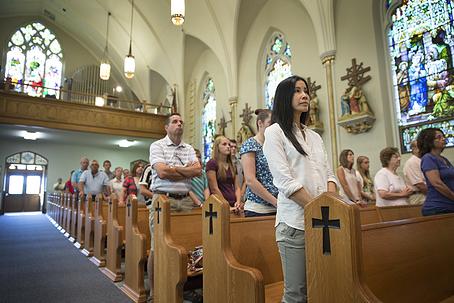
That brings me to what I noticed one day at Mass. Most Catholic church buildings constructed after the 1950s have a few things in common that older churches just do not seem to originally have. Actually and unfortunately, the “new” churches have many things I find irritating on good days and barely tolerable on bad days, but the thing I noticed this one day were the quarantine cells.

Cry RoomThat’s right. Isolation chambers. Also known as baby rooms, or cry rooms, where parents attend Mass with their infants and toddlers, safely behind soundproof windows and walls.

A few questions: how did young families at Mass handle their crying babies before the invention of modern soundproofing? And what did priests and people in the pews do with the cries and yelps and whimpers in the old days?

My thoughts: Baby cries are closer to the songs of angels than we think. I mean, if Jesus said that only the childlike will enter Heaven, then it makes sense that babies belong in the nave, not in some outlying room removed from the Mass, as if they were dangerous to everyone else’s prayers. I even dare say that people at Mass need to hear those whimpers and yelps! It reminds them, it reminds all of us that the Church is young! The Church has young husbands and wives with young children! The Church has loving and patient parents! The Church is fruitful and multiplying!

We need to learn how to listen to babies again. Too many of us find it excruciating and annoying. We throw death stares at hungry and tired children, and we roll our eyes at their parents. Sometimes, we even dream of snuffing out their breaths to gain some peace, and that’s not far from the culture of death…

Shame on us. As if we were never that way ourselves. As if we saw the hungry and tired brothers and sisters on the street and thought them annoying and needing to be quarantined. Those cries convict us if we are bothered by them, and those cries convince us if we could only hear their beauty: that we are all crying to God, crying for mercy, forgiveness, beauty. Crying for justice, love and Heaven.

We’re all supposed to be weeping at Mass. Tears of joy at the Kyrie, tears of sorrow at the sacrifice, tears of ecstasy at Holy Communion. And the whole world is meant to hear our cries, our cries that remind it that the Church is young! The Church has a loving and patient Father and Mother! The Church is fruitful and multiplying!

P.S. Check out what one parish is doing to help parishioners cope with the kiddos.

And I’m not the only one who thinks this. Check out what Pope Francis has to say about bawling babies at Mass.

Closing Thoughts on Korra

The Legend of Korra has ended, and what a series of surprises! I have to say my favorite Books of Korra have to be One and Three. Amon was such a tragic and complex villain, and the peril inflicted on Korra by Amon and the Red Lotus really tested our heroine’s character.

—–1) But let’s take a closer look at Book Four‘s episode 8: Remembrances. This episode was more like a recap to prepare us for the finale stretch, but this was no filler episode. Some intense insight was to be seen:

KorraMakoWhen Mako and Prince Wu are sharing their stories with each other, Mako shares with us what he learned from his time with Korra, and then with Asami. The takeaway here is that when we date, we should be able to breakup without turning our girlfriend/boyfriend into an enemy. If the two do become enemies, then what was the relationship worth in the first place? Obviously then both were too immature and irresponsible with one another’s hearts. Now, this doesn’t mean the two cannot argue. Arguing is actually a healthy thing if the argument is over something extremely important! But it’s vital not to tear each other down in the argument, but to work together and find out the truth. Arguing should strengthen your relationship, not bomb it into oblivion.

But here’s the gem from Mako’s experience, when he says: “I had to figure out who I was without a lady in my life.” This is exactly why it’s so important for boys and young men to have good fathers and big brothers. Boys will stay boys if they don’t have a mature man to guide and challenge them. Boys will stay boys and really mess up their girlfriends if they don’t learn from their fathers how a women should be respected and honored. For Mako and Bolin, they grew up without a father or mother, so we can see now why it took them so long to mature, and to do it the hard way with much hurt and hurting others involved.

This is also a reason why seminarians focus so much on fraternity (the good kind, not the college frat-boy kind) and put dating on hold (either temporarily or permanently). We’re finding out who we are, so that we can better serve and sacrifice in whatever vocation God is calling us to. Because without this self-awareness, then we have no idea what our flaws and strengths are, and without this understanding we can never better or humble ourselves. Chastity and modesty are the virtues that help us achieve this. Men also need more time alone in prayer with God, without the distractions of dating (because dating should only happen after our relationship with God [Love itself] is on the right path — after all, how can you hope to love anyone if you don’t first know Love?). For more about this, please visit ChastityProject.com.

And there’s seemingly a throwaway line from Prince Wu: “I’m not strong like you, Mako! I can’t help being weak! I was born this way.” Yet, there he is, Prince Wu learning to toughen up under Mako’s training. It goes to show that yes, we are all born weak, illiterate, ignorant and with a bunch of other deficiencies, but does that mean we should stay that way? Heck no! And we see the Prince really mature as the season progresses.

—–2) And as for the series’ finale with episode 13: The Last Stand? A few things stuck out to me:

KorraSavesKuviraFirst, the whole series has been recurrent with self-sacrifice. We see this again, but this time Korra sacrifices herself to save an enemy (no one before Jesus ever taught us to do this!). Especially noteworthy is that it’s Kuvira’s own weapon that is going to kill her, until Korra steps in as a body shield. This analogy fits well with how Jesus took on our fallen nature and our sin (our own weapons, our own mess and selfishness was going to condemn and kill us) and died in our place.

KorraBrokenSecond, after both Korra and Kuvira are blasted into the Spirit World, Korra shares that she has finally realized that all the suffering she has gone through actually were blessings in disguise — without them she would not have matured and grown in wisdom, humility and compassion. Throughout the season, she was struggling to find meaning in her near-death experience and past trauma, and it was only after saving Kuvira that Korra understood. This is one reason why Christians believe suffering is permitted (not caused directly) by God, and that just because someone is suffering does not mean it is better for them to die, thus why euthanasia is morally evil (because murder is a sin, but suffering can be for our good as long as we suffer with Jesus).

Third, forgiveness of one’s enemies was found three times in this episode alone: when Asami forgives her father’s betrayals and deceptions, when Korra forgives Kuvira and saves her out of compassion, when Kuvira herself forgives Korra. Earlier in the season, we saw Korra forgive even Zaheer and accept his help! And it’s important to understand that forgiveness does not necessarily mean trusting the offending person again. It means you let go of the resentment you have for the person who hurt you and move on.

BONUS: the final scene of The Last Stand has most viewers interpreting it in a way that advocates for LGBT issues. All we see is Korra and Asami walking into the Spirit World hand-in-hand and turn to face one another. To me, this is more likely to be about the two becoming closer as sisters. We saw earlier how Mako and Bolin grew as brothers, but now we also see how Asami and Korra grew in their sisterhood. This is supported by the fact that the whole series moved from the romance between the friends in the beginning (Mako and Korra, Mako and Asami) to their love of one another as close siblings at the end. To see this love between Asami and Korra as romantic seems a far stretch to me, and is a sign of how lustful and perverse our society has become to see even this simple innocent gesture between them as sexual.AsamiKorra

Yet, even if our two leading ladies have same-sex attraction: all persons are called to love and to be loved, including those of us with same-sex attraction! And to have same-sex attraction itself is not sinful (despite what many Christians wrongly believe), but to act on that love in a sexual way is a sin, because love need not be sexual (if it needs to be sexual, then it ain’t love). In fact, sexual expression is only appropriate in a holy marriage between one man and one woman (not a marriage done for lust, for social gain, for politics and power, for money, for polygamy, etc.), because the marriage vows [of sacrificial love] help the husband and wife prevent sex from becoming lustful, abusive, perverted and harmful to their love. Catholic teaching pushes back against this culture’s lust and perversion with true love that is understood to be genuine and selfless, chaste and courageous. I hope to share more about this in a more in-depth post, but for now, please let me share these insightful videos and interviews of persons with same-sex attraction instead: The Third Way, and the Desire of the Everlasting Hills. And for more authentic and compassionate Catholic wisdom on this topic, please start here.

Well, that’s all I have for now about this latest Avatar series. I thoroughly enjoyed the journey it put me on, and I hope the best for the creators and cast of the Legend of Korra. Pray for them all!

For more about Korra on HolySmack, look here: The Avatar and the Pope and the Passion.

Lisa Ling Visited and Made a Documentary

A few years ago, Lisa Ling visited the Dominican Sisters of Mary, Mother of the Eucharist in Ann Arbor, Michigan to help Oprah viewers get to know how Catholic religious sisters live, love and serve God.

The show was so successful that Oprah asked the sisters to visit her studio! Yep!

But that wasn’t the end of Ling’s fascination with the Church.

KoenigsknechPriests

[God bless you both, Fathers!]

LisaLing2 LISA LING: THIS IS LIFE

This year she visited Michigan’s Sacred Heart Major Seminary in Detroit (I remember her and the CNN crew walking around in the Fall) and filmed a documentary about two twin brothers who just finished formation here last spring and were ordained priests over the summer. This is the episode — Called to the Collar — for your evangelization enjoyment. Find out why Michigan was special enough to beckon Lisa Ling all the way over here!

Interpreting Interstellar

InterstellarA dozen of us from the seminary just experienced in IMAX Christopher Nolan’s latest film: Interstellar. There was so much nourishment in the film to milk, that I’m going to have to return for seconds during Thanksgiving break, but for now, here is what left me most satisfied (and no, it’s not just the Buddy’s Pizza we just inhaled):


—SPOILER ALERT—


—–1) About halfway through the film, the astronauts come to a fork in their journey and have to decide definitively which planet to visit. They appear to have two solid options, but Anne Hathaway’s character – Amelia Brand – chooses illogically and with great bias. The other two crew ask her why, since their choice is more reasonable and has better chances. Her answer made the audience laugh, me included. But then Ameila explained, and I caught myself falling in love with her answer. It resonated with me. I myself thought about it for a long time: Why does love exist? What is the reason for love?

Answer: there is no reason for love, because Love IS the reason.

Here’s what Amelia said, roughly paraphrasing: I choose this planet, and not the one you have decided on, because somewhere on this planet is the man I love. I cannot explain why, but I know my heart, and I’m trying to follow it. It doesn’t make sense, but that’s because love transcends what we can sense, what we can measure and quantify and experiment on. Love cuts through time and space, because even though I haven’t seen Edmund (her lover) for years, I still love him and am drawn to him. Even though I have every reason to think he is dead, I need to be with him, to know for sure. There’s no reason any of us should keep loving people who are gone, who are far off, who we may never see again, but we still love, because love is the only thing the universe cannot explain.

And the reason why the audience laughed was because we thought she was going to be all mushy and sentimental about her choice: Oh, here we go again… all this follow-your-heart and lovey-dovey stuff… bah humbug!

BUT that’s where Philosophy and Theology kick in: it is true that love transcends the world, the universe. It is completely beyond what is necessary for the universe to keep going, and also completely unnecessary. Love, in short, is supernatural; it’s above nature, not found in nature, and does not naturally occur. Animals, plants, and atoms do fine without it. Love can even put us at risk of danger. Nature would be fine (maybe even better) if love didn’t exist, except that it does exist. And if this supernatural thing we call love actually exists, that means there’s a whole bunch of stuff out there that is beyond our science (“stuff” like God, the Divinity, the Creator). The film even lays it out: “Science is about admitting that we know so little.”

 

CainAbel

[Cain murders his brother, Abel. This screenshot is from Darren Aronofsky’s “Noah”.]


—–2) When the remaining crew land on a planet and revive Mann, a huge twist in the story comes up and reminds us of Cain and Abel. The parallels are unmistakable: Mann is Cain, and both are the elder character (Mann was on the planet first and for a longer time). Cooper is Abel, both were the younger character (Cooper arrived later on the planet). Mann tells Cooper (Cain tells Abel) to go out into the field (the wilderness) with him, and that’s when the elder rises up against his brother out of selfishness and seeks to murder him (see how similar it all is to Genesis 3).

Right away, goosebumps filled my epidermis: here they were, in a new world, ready to begin another civilization, and here was the original sin, back with vengeance. Our fallen nature as sinners goes with us wherever we go, even to Saturn, even through a wormhole into another galaxy, even to the edge of a gargantuan blackhole. We cannot rise above without help from outside the human race. Our world/s will be tainted, like the cursed Midas Touch.

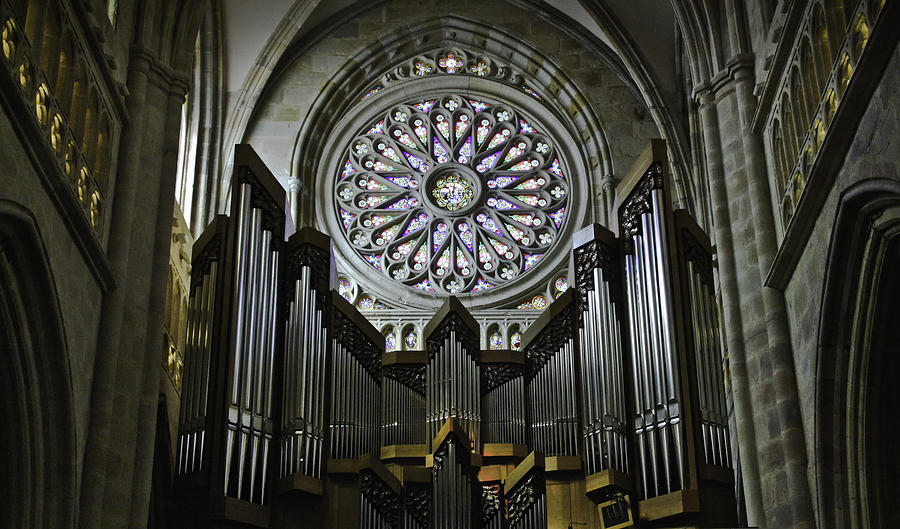
Coincidentally (but probably not), the film’s mighty organ music pipes up during this scene (track “Day One Dark“). Given that the organ is rarely featured in film scores, and the prominence the organ has in this very Biblical scene, one has to wonder what Mr. Hans Zimmer was implying by using this instrument that was adopted specifically for the Traditional Latin Mass of the Catholic Church. [Update: click here for all about the selection of the organ for the score!]
—–3) Jessica Chastain’s character – Murph – goes behind her big brother’s back and undermines him and his [insane] will for his family’s future. The tension builds as he returns to discover his sister’s cunning, and just when we think he is going to do something terrible to everyone, Murph runs out to him, smiling, gushing with hope and love, and she embraces him. Immediately, I knew the phenomenon. I experienced is many times and have dubbed it “Severe Tenderness”. It goes something like this: A few years ago, I was at work one day at the sushi restaurant. My shift on Friday evening was the forbidden hour. I was regularly alone at the front during the dinner rush (4-6pm), taking orders, running orders, preparing dishes, washing dishes, cleaning tables, etc. I learned how to work without thinking, to grow four extra arms, and to lose my temper. But always at 6pm, backup would arrive and pitch in. This woman only worked for two hours (6-8pm), but when she would arrive, I was ready to dump all my frustration out on her. Except, when she came up to me, said hello, asked how I was, and so ready to help me… my anger, stress, and tantrum melted away.

Her smile and sweetness was tender enough to soothe me, yet severe and powerful enough to cut through all the mess that was attacking me. It was instantaneous, and instead of blowing up in her face, I smiled back and worked even harder to help her have an easier evening at work. She became someone for me to serve, and I loved it.

Severe tenderness is a gift, a strength not everyone has, and even in my life there are only a handful of people who have that effect on me, consistently. But don’t go and try to see if you’re one of them, okay?

—–4) At the epic’s end, we find Cooper being sent on a mission: somewhere out there in the new world (new planet) is a new Eve (Amelia). It is not good for her to be alone. Go find her. She’s waiting for you. Be her new Adam. (Yes, strongly echoing Genesis again!) [This also strongly hints how Mary (the true New Eve) comes first and awaits the coming of Jesus Christ (the True New Adam!).]

And when Murph tells Cooper of this, reminds him about Amelia, his love for Amelia is roused. This reminds me strongly of the love story found in the Book of Tobit: the love of Tobias and Sarah. You’ll have to find it in the Bible yourself, read it and watch Interstellar to understand what I am saying. But trust me. It looks pretty parallel to me.

CryoEmbryo—–5) Lastly, Interstellar mentions cryogenic-embryos as part of the backup plan to ensure mankind’s survival. I’d like to point out that the film eventually determines this option to be inadequate, because it means giving up on saving those who are alive. This is not the only reason why cryostorage (super freezing) of human embryos is morally evil, mainly because human persons deserve better than to be left vulnerable in canisters and left there as a resource to tap, manipulate and own. I won’t go any deeper on this point for now, because my philosophy thesis is on this issue, and when it is finished, I’ll be sharing it then. This review is already lengthy enough.

—–BONUS) The biggest plot hole in Interstellar is actually a powerful sign of a something more. Philosophy labels this “plot hole” in reality the Infinite Regress. This is a bit difficult to follow, but hear me out:

      At the film’s end, we discover that:
a) Cooper goes back in time to tell his past self (call this Cooper2) about the secret NASA coordinates.
b) Cooper2 gets the message and goes to the NASA coordinates, and begins his journey.
c) Cooper2’s journey leads him to the blackhole, where he finds a way back in time to tell his past self (call this Cooper3) about the secret NASA coordinates.
d) Cooper3 gets the message and goes to the NASA coordinates, and begins his journey.
e) Cooper3’s journey leads him to the blackhole, where he finds a way back in time to tell his past self (call this Cooper4) about the secret NASA coordinates.
f) Cooper4 gets the message and goes to the NASA coordinates, and begins his journey.
g) Cooper4’s journey leads him to the blackhole, where he finds a way back in time to tell his past self (call this Cooper5) about the secret NASA coordinates…
ETC. ETC. ETC. for infinity…

But, who told the first Cooper [about NASA] in this infinite chain that goes nowhere and leads nowhere? Was it another Cooper? In that case, who told that other Cooper? And who told that Cooper? And that Cooper? And that Cooper? Etc. How do we even know that this chain of events can change?

This unsatisfying answer/explanation is actually a way to dodge the question, because it gives you no knowledge of anything. This is the INFINITE REGRESS, and it shows that we have to find the first person who started off everything, aka: the first causer, the one who is outside of the chain, outside of our universe, outside of Creation, outside of our reality, outside of the Big Bang, the one who started it off and set things in motion. Philosophy (and St. Thomas Aquinas) calls this first cause by the name God. Theology calls Him Father.

For those of you who want to give Philosophy a go, here’s an excerpt from page 217 of the text (The One and the Many) we’ve been studying in class at seminary (to further flesh out this concept):

[from W. Norris Clarke's "The One and the Many"]

[from W. Norris Clarke’s “The One and the Many“]

All in all, despite some shortcomings in the film, the good points far outweigh the bad. I was very impressed, and was left breathless at all the science, philosophy, subtle theology, love and sacrifice blended together in harmony. I loved being tested on how much I knew and if I could follow along, instead of being spoonfed (like how most of Hollywood does). Thank you, Lord, for storytellers like Christopher Nolan and Co., and thank you for creating us with the wits to enjoy such stories. Amen!

BlackHole

Just viewed Interstellar again (Nov. 29th, 2014) and had a few more sweets to share with y’all!

—–6) We find out about the MONSTROUS LIE, the temptation Mr. Doctor Brand (Michael Caine) used to bait Amelia and Cooper on the mission. This scene became clearly alluding to the Original Temptation in Eden, when the serpent lies a monstrous lie to Eve, and Eve’s fall brings down Adam (arguably because Adam did not rise up and smash the deceiver instead!). In this film, we see the same thing play out, and the lie, no matter how good it sounds (because nobody wants something evil, but we all want things we may think are good), is always deeply hurtful to the relationships involved.

—–7) Plan-A, or Plan-B? One of the main objections to Plan-B in the film (and rightly so) is because it gives up on those on Earth. It condemns the living to death, labels them hopeless, and then dismisses them. This reminds me of the Pro-Abortion mentality: a woman becomes pregnant, and since she cannot raise a child because of poverty,diseases, etc., she and others are pressured to abort the baby. The baby is condemned to death and the mother is condemned to murder. The child is labeled hopeless and the mother is hopeless if she does not kill her child. The child is dismembered and dismissed as medical refuse, and the mother is dismissed, left to her own again, so that if she was in poverty then she remains so, or if she was abused and raped then she is vulnerable to being harmed again, or if she experiences post-abortive trauma then she is left to struggle with that alone. Plan-B is the first failure. And Plan-A is amazingly open to the genius of man and the providence of God.

—–8) St. John Paul’s Theology of the Body more than mentions the FEMININE GENIUS, and Interstellar is supersaturated with it. Throughout the film, we see a very strong showing of girls and women who know truths beyond science, beyond logic and beyond explanation. We understand this supersense that is peculiarly feminine as intuition, and we see this when Amelia schools us all about love and its transcendental nature, and we see this when Murph calls the ghost in her bookshelf a person, and we see this in how the love of father and daughter knows no bounds, and how Murph arrests her furious brother’s heart and wins him over (as discussed in #3 above). Just view the film with this Feminine Genius in mind, and you’ll see what beauty I mean.
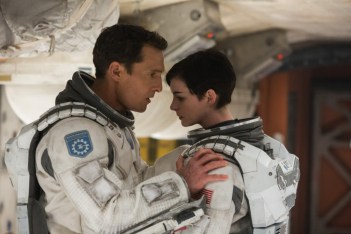
AP CLIMATE FLICKS A ENT FILE—–9) And the New Adam/New Eve typology (symbolism of Jesus and Mary) goes further still! When Cooper detaches from Amelia and the rest of the Endurance Space Station, he plummets into the black hole, sacrificing himself in order to let Amelia rise to safety and continue on to the new world.

Compare this with the Gospel: Jesus Christ surrenders Himself to the Crucifixion, sacrifices Himself and plummets into the place of the dead (aka: Hades). He is buried in the tomb, which is a black hole in the cave, in the ground. His sacrifice allows, actually it propels Mary (as New Eve and as the beginning and perfection of His Church) to rise and continue into a new world, a new redeemed Creation.

Lastly, recall that Amelia also believes Cooper to have perished in the black hole. She thinks herself alone now in the new world. But… Cooper is on his way to her, seemingly rising from the dead, out of the black hole and back to be with her. Now if this don’t sound like the Resurrection

—–And that’s all I got. For now… let’s see what a third viewing brings…

Behold, I Stand at the Door and Knock

Hello Holy Smack Readers!

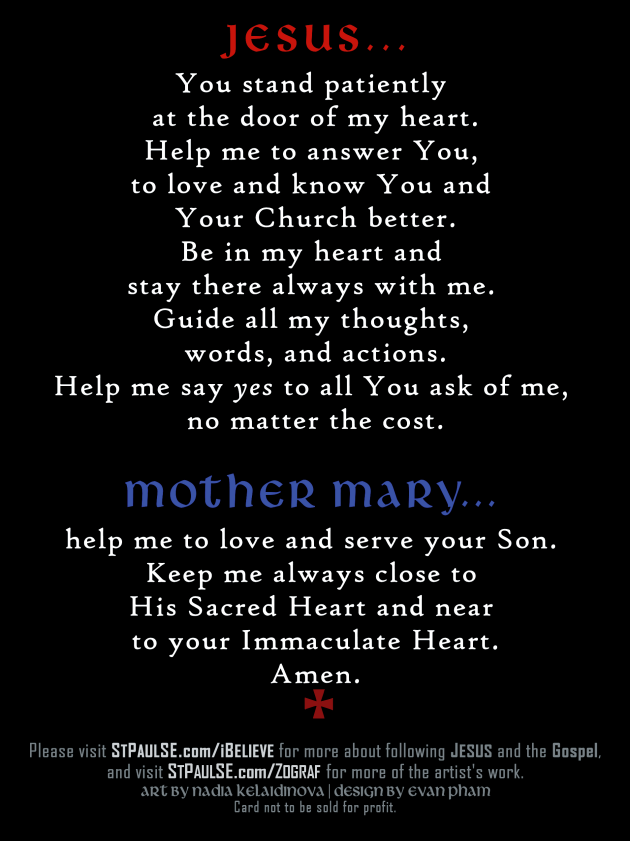
On this Memorial of St. Teresa of Avila, may I present to you the first Holy Card I had the honor of designing for Saint Paul Street Evangelization [SPSE], a group of Catholic Apologists and Evangelists who volunteer to introduce Jesus and His Church to others in public, across the United States! I’ve even heard that this card itself has been slowly spreading throughout America’s cities.

One of the priests here at seminary asked if I would be interested in helping with this mission, and needless to say I was humbled and grateful to God for such a chance to offer my talents to this work. I only hope the Holy Spirit continues guiding me in the good fight against hatred and ignorance of the Faith.

Thank you for reading, and I’d like to especially thank the artist who shared her work so generously for this project: Nadia Kelaidinova (please visit her gallery here). May God bless her ever more abundantly!

Lastly, if you would like a card or so, please feel free to leave me a message on the Holy Smack FaceBook page, or email me at EvanPham@HolySmack.com (Of course, you’re also welcome to support SPSE by ordering from their site. The cards are sold for non-profit purposes only to keep the ministry running.)


JesusAtDoorCardSample

 JesusDoorBack3Sample

Dancing at Dusk

LastDancing HT weekend, a strange group of young Vietnamese Catholic adults gathered beside a lake in rural Wisconsin and found themselves dancing for the Lord at dusk. The following is video footage providing evidence of the ocurrence, and that Evan has learned to shed his shyness of the camera (with much gratitude to the fellow dancers and videographer!)
Yet, before (or after) you enjoy the evidence, please consider why it is that we dance? Why is it that we find it difficult to sit idle and still when a good song comes on? Why can we not brush off beautiful music, or ignore terrible music either? Why do we respond with shudders or dancing?

These are questions for the Theology of the Body to answer, and without drilling into the depths, I’ll say this for now: we have bodies. We were made body-soul, and our body makes visible our invisible soul. Music is a special art that cuts easily into the soul, and depending on the type of music (yes, there are types we should avoid), we respond physically and in certain ways that make sense.

So with these two songs presented below, I’d like to say that I did not sit down and draft out the movements in a technical and premeditated way. Instead, I listened to the music and moved the way the music steered me.

And many others can move way better than I. But this is my blog, so hah…

Praying and Praising with Audrey Assad

The first time I encountered Audrey Assad‘s prayer through music, I was stunned silent. It was during an August sunset, and she was only a guest appearance during Matt Maher‘s charity concert. Before this point, she was only an unknown backup vocalist… but when she started singing her Restless… nobody wanted her to be merely a backup anymore.

Audrey AssadYesterday night I had the chance to see Audrey again on her final tour. So much of it felt like a reunion of sorts, but I also noticed and appreciated the beautiful and subtle ways she has changed since 2010’s experience.

She was not center stage this time — not even close! She put herself off to the side, and made sure icons and masterpieces of the Faith were our focus. The artwork would appear distorted at first, and only gradually become recognizable as we prayed with Audrey through song.

And she didn’t just sing, but she led us in prayer. She moved away from the mic and would let us take over — hinting to us that our voice is beautiful too. We needed to pray while she hushed.

And hushed… and hushed until she backed away from stage, unknown to us. She left us praying and praising Christ at the end, herself decreased to the point of absence, Himself increased to the point of sole presence.

It was clear she wanted to remind us that we were gathered there for Jesus — not for anyone else, not for her. Even after the whole show, she was nowhere to be found, because she wanted us to find Christ instead.

And I think a lot of us did find Him.

As my brother seminarians and I drove home after, we prayed and praised God the whole way. I really don’t think the other fans were doing anything different either as they went home that night.

Thank you, Audrey [and Bellarive!] — may Mary keep you and your beloveds close to her Son’s Sacred Heart always.

Some favorites:

Lastly, check out this post for how to move to Audrey’s You Speak… yes, you read right: move. As in dance. With me.

How Women in Veils Inspire Males Like Me

[The following post is in honor of Pope Saint Pius X, whose memorial is today, and the Coronation of the Blessed Virgin Mary, which we honor tomorrow.]

Ever since I rediscovered the Extraordinary Form of Mass for myself, being Roman Catholic has never been the same. In fact, three big markers pop out of my timeline of Catholic living: when I encountered the Theology of the Body, when I met Mary, and when I discovered the Tridentine Mass.

Over the past few years of attending Tridentine Masses whenever I could (each time a wonderful treat!), one of the things most noticeably distinct to me are the number of women — young and old — who don the chapel veil (aka: mantilla). I always felt different at Mass and worship in the presence of these women in veils, but I didn’t know why (or how so) until this past weekend in the most unlikely of places…

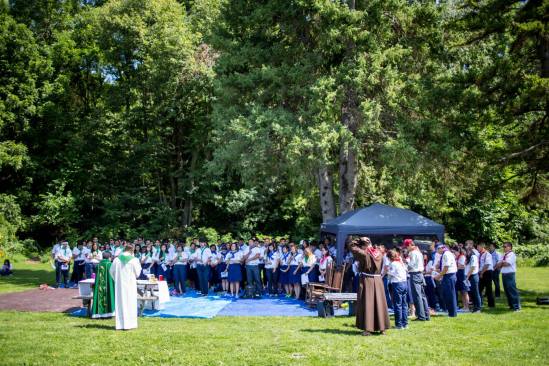
Mass at CampI was at the Midwest’s annual weekend training camp for leadership in the Vietnamese Eucharistic Youth Movement of America. Just before our opening Mass in an open field, in the humble shade of a tree and under the gaze of the morning sun, one of my dear friends beside me pulled out a white lace veil and draped it over her hair. It was out of the corner of my eye, but I saw everything in slow motion. I could not believe what I was seeing, and how it lifted my heart. Instantly, I felt a rush of reverence: if she could humble herself so much before Jesus… then how much more should I long to join her in worshiping Him! Her simple gesture to honor Christ floored me, and inspired me to show at least as much reverence.

And then, I found out she was not the only one. Throughout the Masses we shared at camp, I saw another young woman under a veil. As she approached Jesus in the Eucharist, as she knelt before our King and received His Communion, I found myself no longer able to stand before the Lord. The simple and passing beauty of the scene between the King and His daughter made me feel unworthy of beholding it so. I turned my eyes down… I wanted to crawl to Communion because my soul could sense the holiness present. My humble little heart could not handle the beauty.

I know not why it was this setting, this weekend, this event that helped me see how women in veils could help males like me worship, but I praise the Holy Spirit for the gift of this experience, for the gorgeous gift of these women. Thank you. And to further the glory of God, I asked these women to personally share with you their beautiful story…

I’m an all-in-kind-of girl, and as of that, I’ve come to realize that my inability to commit partially is both a blessing and a curse. In any case, it is most definitely the reason why I usually find myself, either, fatally wrong or unshakably confident.

My decision whether to veil or not to veil was no exception. Unbeknownst to me, my discernment process started a few years ago as casual curiosity and admiration. I didn’t have any strong feelings towards it, other than, “Wow, that’s beautiful and holy looking……. I probably shouldn’t wear it.”

But then, through my encounter with the Theology of the Body and the Blessed Sacrament, my understanding for the Church, worship and the nature of God developed — and I wanted to participate in my faith more fully.

It started with my decision to dress more modestly — by replacing my skimpy bikinis with one piece bathing suits.  I avoided controversial situations, like getting drunk while bar hopping in leotards — or just getting drunk, period. (I’m not really sure why I ever thought that it was appropriate to wear leotards as a complete outfit). But bit by bit… all these little changes restored my self image as a child of God. It helped me see myself how my Creator intended me to be. I became more aware of how I needed to represent myself as part of Christ’s body, so much so that I became uncomfortable when I misrepresented myself — and thus misrepresented Christ.

But the holy smack didn’t happen until a few months ago, when I was listening to Tim Staples, an apologist, talk about how Catholics are missing the point of Mass. It’s not just about us ‘getting fed’ but instead the Mass/Sabbath is a day, set aside to give God the praise and worship that is just.  It’s the time to fall to our knees to ask for forgiveness, grace and mercy. It’s the time to glorify Him and hail Jesus to be our true Savior.

Worship is not a matter of my feelings, it is our response to faith.

Furthermore, when I reflected on Scripture, and saw how Jesus references the Church as His bride. The pieces started to fall in place and I understood more clearly, what my Living God was doing. Day-in-and-day-out, upon that altar, He was keeping His Word. He was coming to us, as a MAN. He was offering Himself — completely and fully to us. He was re-establishing a covenant.

Jesus was all in.

[Korean Figure Skater, Yuna Kim, wears the veil.]

[Korean Figure Skater, Yuna Kim, wears the veil.]

This brought me to my knees — literally. I not only genuflected before the Eucharist, I went down on both knees. I am a mortal human that has been chosen to be a temple of God…! I was in the presence of a king. I was receiving Christ! And I wanted to do what was just and deserving of that honor.I begin to prepare for Mass differently. I hung onto every word of the liturgy. I humbly, surrendered and re-committed my life to Jesus, each and every time I received Him.I am a woman, claimed by Christ, Himself.So, what about the veil? Well, there’s no high theology here. It just made sense and was fitting. I want to submit myself before the Lord.  I want to embrace my role as a woman in the Church. The veil represents something that had changed WITHIN me. It is an outward sign of a commitment made in the depths of my heart and soul. So with unshakable confidence — I wear it…’Cause I’m an all-in-kind-of girl.

-Santa Thérèse

The beauty of the mantilla never struck me until reading Crystalina Evert’s blog on the Chastity Project; before, it had just been some weird headdress that old women and younger, presumptuous girls wore to Mass to show off their holiness.  Little did I know that those women didn’t wear those veils because they thought they were holy – it was because they needed to be holier.

Before Vatican II, women were required to wear a chapel veil to Mass in order to show reverence to the Lord on His day, as well showing the world that they, as women, were sacred enough to veil and be protected from the world around them.  The sacred should be veiled, as the Eucharist is protected in the monstrance, the tabernacle, and under the veil during Mass.  After Vatican II, the requirement of wearing the mantilla was taken out of Canon Law, and feminists in the 60’s denounced wearing it because they believed that it was a symbol of slavery to men and to the church, and so the beautiful tradition of the mantilla faded away.

When I read Crystalina’s thoughts on the mantilla, the idea of wearing one intrigued me, but I brushed it off because I didn’t want people looking at me funny or thinking I was getting above myself.  But the image of the veil kept popping into my head, incessantly and constantly.  I decided to pray about it and leave it up to God to show me what I should do, because if I was going to go all out Mary-style, I needed to know exactly why I would.  In the meantime I did some research on it.  I found that several First Ladies, including Jackie Kennedy, Nancy Reagan, and Michelle Obama, all wore veils upon meeting Popes John Paul II, Benedict XVI, and Francis.  If powerful women felt the need to veil themselves in the presence of the Holy See, why shouldn’t we veil ourselves in the presence of Jesus in the Eucharist?  Not only does the veil show that women are sacred, it also helps you grow into your sacredness.  The wearing of the mantilla promotes the growth of virtues such as chastity, purity, humility, and modesty, all of which are exemplified in the Virgin Mary, who is always depicted wearing a veil.

[Icon by Mina Anton]

[Icon by Mina Anton]

The more I read, the more I felt that God was calling me to be more like our Mother, and to emulate her in everything that I do. Like Crystalina, I loved the idea of being covered by the Holy Trinity and being protected by it.  My boyfriend bought me a white mantilla, which is the traditional color for unmarried women, made of Spanish lace as an homage to my patron saint, Teresa of Avila.  Wearing the mantilla makes me feel like I am alone with Christ during Mass; everyone else melts away, and it’s just me and my maker. I feel more alert, more open, more joyful, and even excited when I get the chance to put it on. I feel even more excited when people ask me about it, because it gives me a chance to share my love for the Holy Family and Holy Trinity.  I love the feel of the lace on my hair, like the caress of a parent’s hand on their child’s head.  I love the way the veil frames my line of vision when I look at the Eucharist.  And I love being able to grow closer to my heavenly Father and my Blessed Mother.

-ANonymous

“And this is why the female body should be veiled because everything which is sacred calls for veiling. When Moses came down from Mount Sinai, he veiled his face. Why did he veil his face? Because he had spoken to God and at that very moment there was a sacredness that called for veiling… Veiling indicates sacredness and it is a special privilege of the woman that she enters church veiled.” –Dr. Alice von Hildebrand

More thoughts on the mantilla from around the Catholic blogosphere:

1) I Love My Chapel Veil

2) Notes from Beneath the Veil

3)And here’s a video on the veil! 

First Year Seminarian

Two months ago, I crossed the finish line of my first year as a seminarian (aka: full time discerner of my vocation). Since then, it’s been hectic gearing up for and going on summer travels. In the year since I entered seminary, so much has happened in so little a time span that I’m tempted to think nothing happened at all. But now that I’m in a bit of a slowdown in between summer travels and events, here are some positives that I have to share:

1) I lived childhood shyly. I lived adolescence even shier. But then my twenties saw an outspoken Evan, and today I am more confident than ever before. I don’t know exactly what happened in this first seminarian year, but I can stomach the butterflies in my stomach a lot easier, and that jittery heart is much calmer now. (Yes! I don’t have a heart problem, after all!)

2) The Church loves her seminarians. I never knew how much until now. I have been so spoiled with support, prayers and pick-me-ups, sincere friendships with other seminarians and with priests, chances to waste time regularly with Jesus, and plenty opportunities to get out of my comfort zone. I have to be careful not to take these for granted.

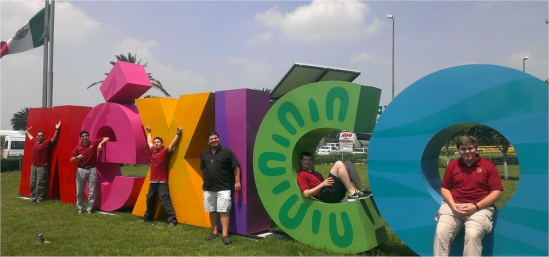
Jumile3) I got to travel to Mexico for six weeks for pilgrimage (Viva La Virgen de Guadalupe!), language and culture learning, and witnessing to others. I literally did not know I was being sent there until last December! And now, I know that Spanish is more challenging to me than Latin (or Chinese or Vietnamese)!  I also know that I have friends there who I was very blessed to meet. Oh, and I even know that little bugs called jumiles taste just like mint leaves. Yum!SHMS Mexico
NameTag4) I have met more people this past year than probably in the last five! Thus one of my weaknesses has been revealed: I have a hard time remembering names and faces. I really need to have a lengthy and personal conversation with someone before it clicks in place. (Please don’t take it personally!)

5) I move from place to place pretty painlessly. When I first moved into the seminary, I was pretty sad, not just because I missed home and my family, but more so because I hated the thought of my family being lonesome after I left. But, they were okay I think. And so, when I went to Mexico, I didn’t really get homesick for the States. And when I returned to the States, it felt like I never even left. I just shrugged and got back into the swing of things. It really does not feel like I was there, and when I left the seminary for summer break, I found it hard to believe I lived there for eight months. It all still feels more like a weekend retreat… hmm…

DarkKnightOST6) I love exercising, especially to the roar of Hanz Zimmer’s Dark Knight scores when I bike or run… and to the bass of dubstep/EDM when I do weights. Yes… I didn’t know this about myself until I found myself staying in the seminary gym for almost four hours one night (the music was on repeat, and apparently I was too).

7) Got a lot left to learn about prayer and how to keep it up regularly.

8) And finally, I realized that I need to go onto year two and keep discerning the priesthood and growing in the Christian life.

RomanCollar