Lovers of Liturgy

Late have I loved Thee, O Beauty ever ancientever new, late have I loved Thee… 

So said Saint Augustine, referring to our Lord. Yet, similar may be said of the things which reveal Him to us: the endless ability of His dawns and dusks to awe, the overwhelming stars of night compelling our staring, the expansive sea drowning us in wonder, and the simply pure laughs of babies filling our ears with bliss.

So too with a Mass that inspires awe, stares, wonder, and joy. Can anyone imagine being star struck over the Novus Ordo Mass (NOM, est. 1969)? Do any faithful Catholics ever relish its shortened prayers, its suspicious origins, its banal fabrication by committee (as Cardinal Joseph Ratzinger said before his rise to the papacy), its mess of options, its bracketed readings of Scripture (for shortened form, omit the text in brackets), and even its deliberate redaction of key Catholic beliefs from the “new and improved” Lectionary?

But then here’s a trilogy of films, labored over by independent and artisan film makers, aided by dozens of well-known faithful Catholics, funded through crowd-sourced donors, all head-over-heels in love with the Traditional Latin Mass (TLM, est. too far back to know for sure). These faithful can’t stop telling others about this beauty they’ve found, like a young man who aches to tell the world how he found his beloved bride. To us, the TLM is worth the commitment, the money, the hundreds of miles on foot (see episode 3 for the reference), the pleas to popes, and the skirmishes with schismatic-ish Catholics who have forsaken their inheritance for cheap, modern, synthetic, mass-produced substitutes. What is merely trendy and timely will always whither for lack of roots. What is timeless, rooted deep in hearts and souls, will endure beyond the end. Timelessness > timeliness.

But enough from me. Watch for yourself what true lovers of liturgy have to say, and then find a TLM for yourself (before they’re canceled by fakeful preests, bishups, cardinulls, and poaps).

There Will Be Blood

SurgeryPrepI was at a Tridentine Mass and the priest was vesting in the sanctuary. Altar men in full cassock and surplice were assisting the priest, like how nurses assist a surgeon before the operation, like how technicians assist an astronaut before launch, like how safety personnel assist engineers into haz-mat suits before a mission.

Yes, it was complicated, those Extraordinary Form chasubles of antiquity. But as I watched the priest vest in chasuble and maniple, my imagination took off (as you can see) and my mind stopped when I saw the symbolism. And when I saw it, I could never unsee it. Permanent and powerful.

Vestments

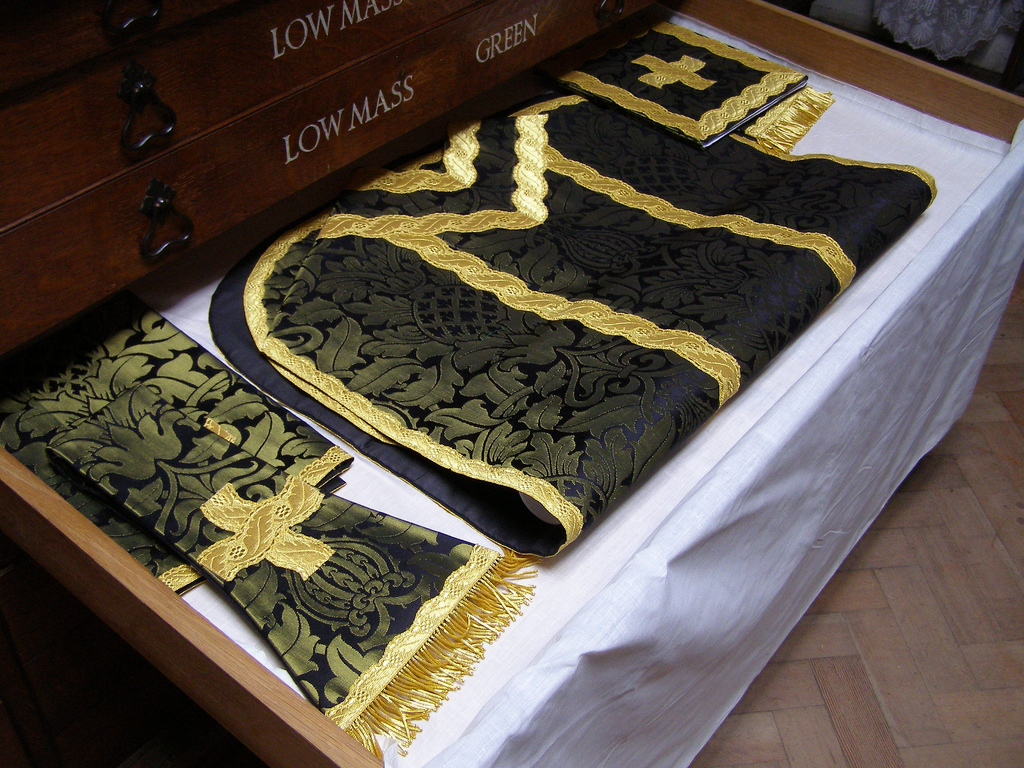
The chasuble was a giant apron, not unlike the kind that a dentist buries you under before they take X-rays of your jaws and teeth. The chasuble is thick, heavy and dense, and looks almost stab-proof.

Now why would the Church vest her priests in these bulletproof vests… err, aprons?

Why?… I wondered.

Because there will be blood. Because there will be BLOOD!

It’s going to get messy at Mass. It’s a sacrifice… the Lamb will be slain, the priest will fill a chalice with its precious blood, the priest will feed us with fresh flesh from the Lamb.

So of course a chasuble is necessary!

FinalChasubleManipleBurseVeilBut now, what about that maniple? That fancy, overgrown handkerchief pinned onto the priest’s left arm? It hangs down by about a foot… so obstructive (right?)! Why would that be important…

Because there will be sweat. Because there will be tears shed.

Worship and sacrifice is hard labor. Prayer and service for an hour before an altar, lugging around all that armor, deciphering all that Latin, chanting all that time, expressing all those gestures and postures, genuflecting, stooping, bowing, kneeling and weeping, and more…

So of course a maniple is necessary!

Because love is hard work, because love involves tears, sweat and blood from the lover and from the beloved. And love is the only thing worth it all.Ghent Altarpiece by Jan van Eyck

The Priest Disappears

For most of my life, I’ve been going to the Ordinary Form (aka: the Novus Ordo, the New Order) of the Roman Catholic Mass. It was the Mass I was born into, grew up with, and still appreciate. It’s the Mass of Vatican II, the Catholic Mass of today.

But once you taste the sushi, the steak, the cake, the wine… you just don’t wanna settle for the canned tuna, the burger, the Twinkie, the Hi-C. (That’s not to say you can’t have a really good tuna sandwich, gourmet burgers, and fresh homemade creme cakes with organic fruit punch, though!)

Sushi!

Mmmm… Mmmm!

Hmmm...

Hmmm…

And once I tasted the Extraordinary Form (aka: the Vetus Ordo, the Old Order, the Tridentine, the Traditional Latin Mass), I just found it more and more difficult to feel satisfyingly fed at the Ordinary Mass. I mean, even the name itself sounds… not-extraordinary.

Well today (October 13, 2013, World-Wide-Consecration-to-Mary Day!), a few fellow seminarians invited me along to the Tridentine. I was surprised at first, because we had just went to a Mass! At the Cathedral! Five minutes ago! But at the same time, I felt like someone was treating me to a banquet — how could I decline? How?

So I went to Mass again, twice within four hours!

And WHAT A DIFFERENCE.

I could give dozens of reasons why I’ve grown to love the Extraordinary Mass. Ever since my first encounter with the EF in 2010-ish, I’ve seen my love for the Liturgy and my reverence for the Eucharist mature and ripen. The Tridentine has taught me how to worship, how to pray and praise, and how to serve the Lord.

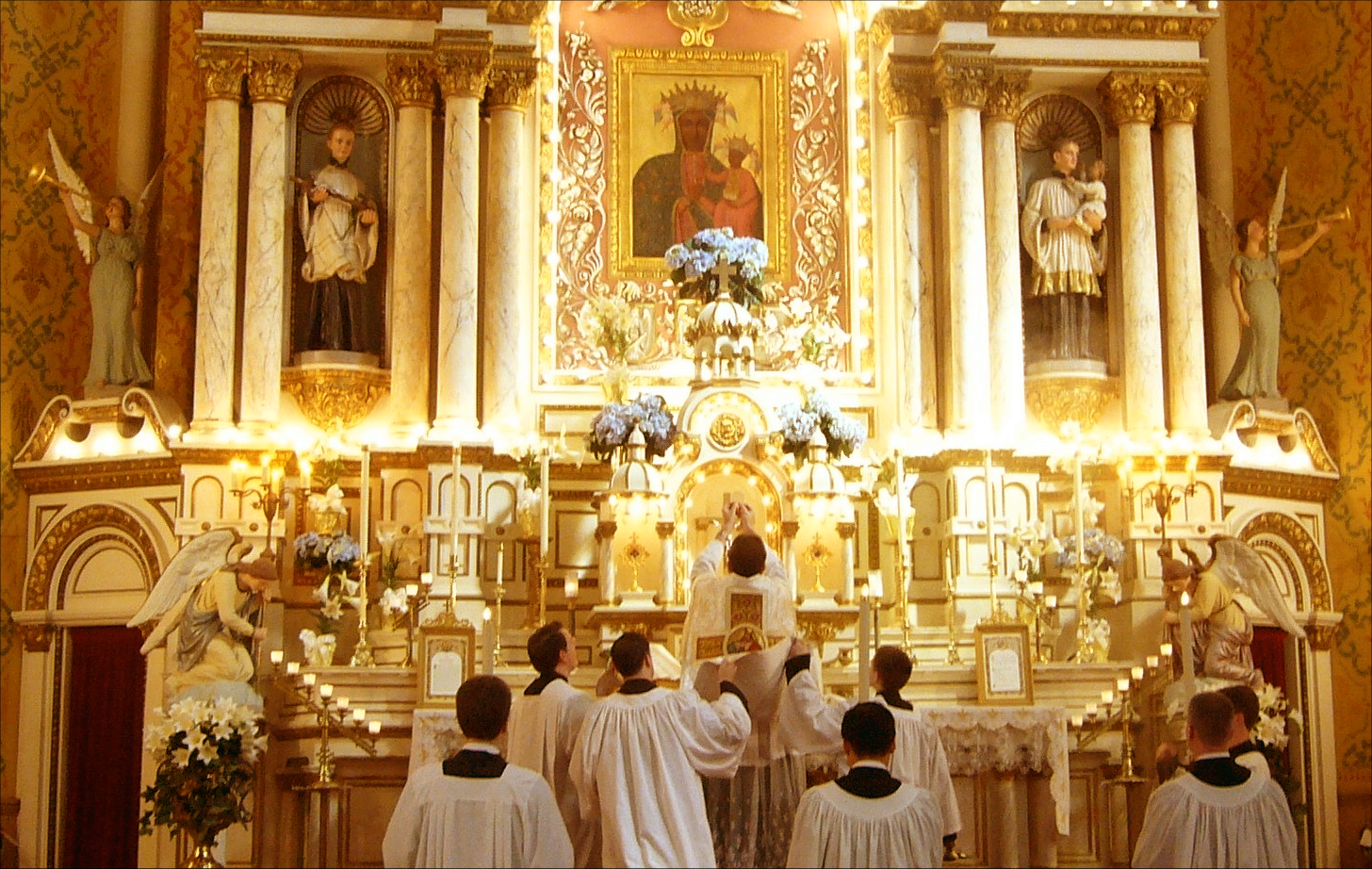
And today at Vetus Ordo, I noticed yet another reason why: the priest disappears.

That’s right! The priest — he disappears!

I found myself wrestling with the prayers, exercising my soul, working out my mind and disciplining my body. Then I looked toward the High Altar and couldn’t see the priest. “Wait, where did Father go? Where… hmm… OH! There he is!”

So what happened?

I meditated on what just happened (the silence of V.O. Mass let’s you do that easily) and I realized: Mass is really not about the priest. It’s not about his homily, not about the jokes that he shares, not about the stories he relates (good as some are).

No. Mass is about the Lord. Mass is about Christ sacrificing Himself for love of us. And about Him feeding us with Bread from Heaven, with True Food and True Drink (John 6: 48-69).

And the servant of the Lord — the priest — knew Who was the focus of Mass. The priest submitted himself to Jesus, submitted so much so to the Church that *poof* he disappeared.

I must decrease, and He must increase (John 3:30). Right?

Bon Appétit!

*Please see this short video for more*

The elevation of the Blessed Sacrament.

The elevation of the Blessed Sacrament.

UPDATED [Jan. 20, 2018]: My intuition is only further affirmed by this quote taken from this article from OnePeterFive:

In the Old Mass, the personality of the priest does not matter. His office matters, and he and the people together are facing the Lord. Conversus ad Dominum. And for that reason the role of the priest is an objective one. It’s not subjective, and for that reason he disappears. That is, obviously, he is the mediator between the congregation and God, leading the congregation toward God, but because of the objectivity of the structure, he disappears. That is very salutary, because the Mass is not about the priest; it’s about God. In the Novus Ordo, because of the versus populum practice, and because of all the options of the priest inserting something like a comment, or spontaneity, the role of the priest becomes terribly subjective. Therefore, he becomes the focus of attention, so the New Mass is terribly clericalized because it’s all about the priest, as opposed to the Old Mass. And this is unfortunate.