[WARNING: what follows is an interview that reveals the details and depths of Little Miss Lucifer: The Legend of the Exorcess. SPOILER ALERT.]
—
—
—

—You: Obviously, the title here again summarizes what’s happening in this chapter, right? I mean, the sister comes home, running and running home. I like how you describe smells, views, sounds and even what she feels. Very visceral.
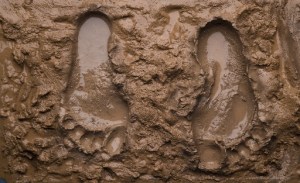 —Evan: It actually came a bit from personal experience. I remember being on my feet all day, heels aching, toes all stiff, and then stepping into soft cool earth. It was amazing how good it felt, especially since it was summer and everything was so superheated. It was like a massage just standing in the soil… similar to digging your foot deep into a beach volleyball court, deep where the sand is cool.
—You: Next time I’m at the beach, I’ll have to try that. But of course, there’s plenty of beaches where you live right? Great Lakes State?
—Evan: Definitely, lot’s of water.
—You: Speaking of water, I was a bit unsure of the third paragraph in the chapter. I mean, I think I know, but it’s so very subtle… Her heart bounces between her juggling lungs – forces blood throughout their bodies. It ripples her womb’s waters. She slides her hand under her belly – cradles with one hand and braces against the wall with the other.
I’m thinking here she’s very pregnant.
 Yet again, she just ran all that way home from wherever she was before, some sort of laboratory or hospital. And the setting she’s in now, rice paddies and dirt roads, tells me she’s nowhere near the city.
—Evan: If you can’t tell, I have a smile on my face. Haha, so then what’s your uncertainty? It sounds to me you’re understanding just fine! I mean, a heart that pumps blood to two bodies? A womb filled with water? A hand cradling a belly? The other hand gripping the wall?
And if you think it’s nothing short of miraculous that she could run all that way home… well don’t forget too soon what the previous chapter was…
—You: Right! Divine Intervention. I guess that sort of explains things and also leaves it a mystery. But tell me about these pieces of familiar faces at the bottom of the page. I see later that the woman is holding ceramic skeletons. Are these statues of saints?
—Evan: Is that a question? Because it sure sounds like an answer to me.
—You: Psssh! But is it the right answer?
—Evan: I hope so! That’s what I was aiming to describe, after all.
—You: And these are smashed, hence the litter, the shards, the pieces and the nettlefield. Great metaphor by the way: nettles are so annoying and painful to step on!
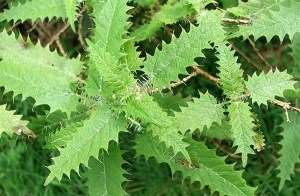 —Evan: Not to mention I just realized that “nettle” sounds awfully like “needle” too… wow.
—You: And speaking of similarities, I found an ambiguous sentence, and I really like it: “She stoops to touch the Virgin Mother’s cheek, brings it to her left cheek.” I mean, does the sister bring the broken half of the statue’s face to the other half? Or does she bring the broken half to her own face? Like how people touch cheeks when they say hello in some cultures?
—Evan: Actually, I prefer to leave that ambiguous. But I’d say both understandings show how beautiful some ambiguities can be.
—You: Tell me about the statues though. I see three: the Virgin Mary, Her Most Chaste Spouse, and a broken boy. Who are they, and what are the statues for?
—Evan: I’m glad you asked. It’s like when people use a phone, especially when talking with a loved one. People smile at their phones, whisper at their phones, sing into their phones, and say “I love you” to their phones – but are they showing affection for their phone? Or are they using the phone as a way to connect to the beloved at the other end of the line?
 The phone is just a medium, a conduit, a fancy pair of cups tied together with string. Now that we have smartphones and video chat, the analogy gets even better: we’re human persons. Humans have ears and eyes, skin, nose and tongue – we can sense: hear, see, touch, smell and taste. And we need to. As Christians, we believe God made us and that He knows what He’s doing, that He made the physical body a good thing, and that humans need their body to be human!
 So when we pray, we not only use our mind, voice and hearing, we want to use our sight and touch. We want to have beautiful eyes to gaze into, patient ears to whisper to, and open hands to hold. A statue serves that purpose. Of course, we would much rather have the person physically there with us, but it’s not always possible. Think of the times a mother remembers and thinks of her child when she folds their clothes, or when a father thinks of his child when he looks at an old photograph – that’s exactly what Catholic statues, icons and relics help us do. We don’t worship or love the object, but we use the object to remind us, to connect us with the beloved. The objects help engage more of us, not just engage our mind but also involve our bodies. As fallen humans, we need all the help we can get when we pray.
In fact, we want so much help that we pray to the saints. We know we can go straight to Jesus in prayer, but some of us don’t exactly have the confidence to do so, and some of us need to start off with an introduction. We see this sometimes when a father is upset with a son or daughter. What does the child do? He goes to his mother and asks for help, asks what he should say to Father, when and how to approach him. This basically explains why some Christians ask the saints for intercession.
Because we also believe the saints are those of us who have risen to Heaven, and they are closer (spiritually closer, and in the Virgin Mary’s case – also physically closer!) to God than we are here on earth. In Heaven, we also become more human than we are here on earth. Here, we have defects and deformities: sin, death and evil. In Heaven, we are what God made us to be: fully pure and alive, immortal and royalty. There’s a crown waiting for each of us. Thing is… do we want it enough?
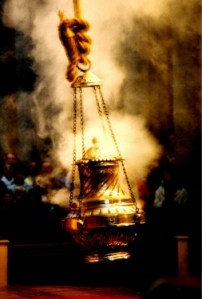 —You: Wow, that makes sense… it reminds me of the phrase “smells and bells” when people think of the Catholic Mass. The priest uses incense and there are bells being rung at important moments. So, even our sense of smell is brought into use in prayer!
—Evan: And our sense of taste! When we receive Holy Communion, the flavor of bread and wine engage us. That reminds me of a time when I received the Eucharist and had a sort of mini-mystical experience. I won’t go into it now… probably save it for the later chapters.
—You: Hmmm! Interesting. I haven’t seen things that way before. I like how it’s not all intellectual, but also sensuous.
—Evan: That’s why ugly or plain churches are such turn-offs. Think about it: if God is Beauty itself, and His Church is the Mystical Body of Christ, then shouldn’t the building that we gather in be decent? If not dazzling? There’s another reason for the beauty, but I’ll also leave that for a more relevant time. Something to think about for now.
—You: Yes, and for now I’d like to know what/who “Her Most Chaste Spouse” is referring to…
 —Evan: Ah… that’s one of the titles (like a nickname) for Saint Joseph: also known as San Jose in Spanish! That’s right… the city in California is named after him. We call him Mary’s Most Chaste Spouse because he loved his wife (Mary) with a superhuman and chaste love, a love that was lustless and self-sacrificing. I understood this nickname of his even better when I heard one of his other titles: St. Joseph, the Terror of Demons. Yep… he terrorizes demons. They loathe him, avoid him, and fear his holiness. Because he refused to lust after Mary, the devil couldn’t bait him. Most of us, men especially, fall into lust because we don’t have the strength or know what true love is. True love is always chaste: honest, sincere, unselfish and faithful. Think about this… Mary is the most beautiful of all of God’s creations (If you were God, wouldn’t you make your mom perfect?), and since Joseph was her husband, it must’ve been quite tempting for him to use her for his selfish gratification. But… her beauty was so out of this world, that it inspired him to love her with a love that is also out of this world.

The Holy Family
[Click the icon to visit the artist’s page!]
And the love that is out of this world is Divine Love: God’s love… holy, pure, generous, faithful, fruitful, free, and total. In Greek, this love is called Agape: the love that would sacrifice itself for the beloved’s well-being.
—You: I never ever knew that! Wow… St. Joseph. And of course then, in this chapter, the broken boy that his arms are holding is the baby Jesus, right? I like that image, almost like a forewarning of suffering… like the child will suffer…
—Evan: I like how you out that! The Child Will Suffer. It’ll make a nice title for a future work!
—You: Haha, you’re free to use it as you please. But last question now: is that a Chinese flag hung up over the altar? Like, “a red flag of yellow stars”?
—Evan: I’m pretty sure the Communist-Chinese flag is the only red flag with yellow stars, right? Haha. I know the Communist-Vietnamese one is also red, but with only one yellow star. But yes, you’re right about the flag in this scene. It’s important to also remember that it’s communist.
—You: I see the antagonist in the story is being built up. This is a story of political struggle, too then?
—Evan: I’d say struggle isn’t strong enough of a word in this case.

![[The view from the street! Notice how warm it looks... lush plants, subtropical... definitely not amidst polar vortex.]](https://holysmack.com/wp-content/uploads/2014/01/4021730613_3ee9b44b39_o.jpg)
![[Look! There's a mural! You can tell by the clouds this ain't Medieval or European or American or anything like that. Betcha neva seen Jesus look like that before!]](https://holysmack.com/wp-content/uploads/2014/01/4021714073_500bb66270_o.jpg)
![[But we all know the real razzle-dazzle of a reverently raised Catholic church is inside! I mean, Benedict XVI did say that stained windows look dark and dreary outside, but from within... BAM!]](https://holysmack.com/wp-content/uploads/2014/01/4022255943_e7996e3644_o.jpg)
![[The ceiling! There ain't an inch untouched by brush in this church! That's what I'm talkin bout! The beauty of God moves us to create beauty!]](https://holysmack.com/wp-content/uploads/2014/01/4021996321_8d41b6dba9_o.jpg)
![[Here we are, gazing up as we move through the nave.]](https://holysmack.com/wp-content/uploads/2014/01/4025209421_d8d39012b6_o.jpg)
![[Red columns support the ceiling here, probably columns of wood since Traditional Chinese architecture for sacred spaces tended toward precious woods (like teak) rather than precious stones.]](https://holysmack.com/wp-content/uploads/2014/01/4025969890_dc4b1c6aac_o.jpg)
![[Looking up at the sanctuary, we see a Chinese depiction of the Holy Trinity: God the Father in the center, God the Son (left), and God the Holy Spirit (right).]](https://holysmack.com/wp-content/uploads/2014/01/4022785736_03fa04142e_o.jpg)
![[Peering up, we notice the doves descending, a sign of the Holy Spirit's descent upon Christ at His Baptism, and at our baptism.]](https://holysmack.com/wp-content/uploads/2014/01/4026023740_a7863a4d45_o.jpg)
![[The fresco here, right above and behind a very Chinese tabernacle, illustrates the Last Supper.]](https://holysmack.com/wp-content/uploads/2014/01/4022700306_8986055773_o.jpg)
![[Then of course, we tun around and see what's behind us: a mural of God in Creation-mode, among other stories and saints.]](https://holysmack.com/wp-content/uploads/2014/01/4022928180_9414c2d545_o.jpg)
![[A close up of the mural's left. Notice the Genesis story in the circles.]](https://holysmack.com/wp-content/uploads/2014/01/4022331297_704116fb55_o.jpg)
![[And here's a close up of the mural's right. See the dinosaurs? See Adam and Eve?]](https://holysmack.com/wp-content/uploads/2014/01/4022303555_d3e7d53fcb_o.jpg)
![[And before you leave, make sure to stop by the shrine of our Lady: Mary the Mother of God. Baby Jesus is in there, too!]](https://holysmack.com/wp-content/uploads/2014/01/4021760421_cf36b39890_o.jpg)
 Oh Mary, conceived without sin, pray for us who have recourse to thee.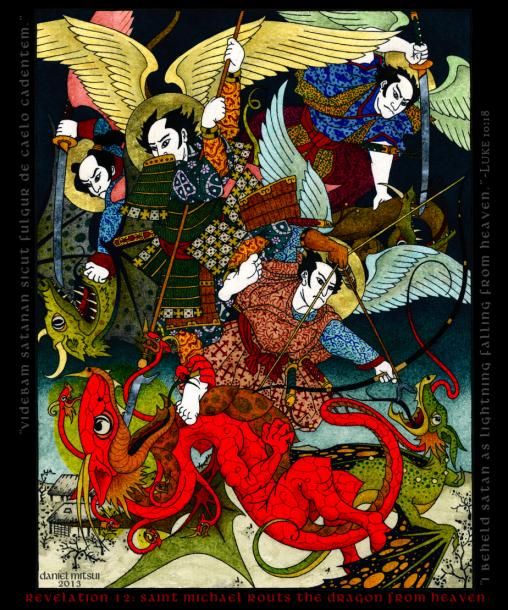
 At first I thought it was some kind of seaweed, or coral. I told my friend but he said people don’t even fish in the river, how could there be seaweed if there’s not even fish? I didn’t know the answer so I ignored him and picked up the red flesh. It fit completely into my left palm. It felt like the strawberry jelly I ate for lunch.
 So Wu was easy for me to recognize on the stained anklet. I found my friend’s name too and told him to come see, but he wouldn’t. He told me to stop touching the babies. I said why would anyone put babies in bags? They’re just hands and legs.
![[above is the 5th page of notes from my Philosophy 225 class: Ancient Greek Philosophy]](https://holysmack.com/wp-content/uploads/2014/01/phl225pg5.png)
![[above is the 2nd page of notes from my Latin 122 class: Introduction to Ecclesiastical Latin]](https://holysmack.com/wp-content/uploads/2014/01/lat121pg2.png)
![[above is the 4th page of my Philosophy 350 class: The Philosophy of Nature]](https://holysmack.com/wp-content/uploads/2014/01/phl350pg4.png)



 A nun is different from a religious sister in the same way a monk is different from a religious brother. Nuns and monks are cloistered, meaning they lock the world out so that they can focus on a simple life and pray the rest of their lives, praying for you and me, praying for those of us who have no one to pray for them. In fact, that’s kind of what
 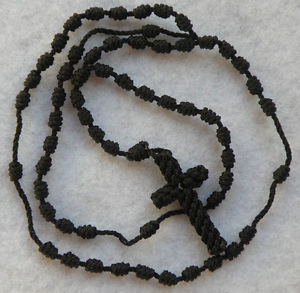 —Evan: They can be beaded, but the simplest ones are just a series of barrel knots. I actually like these cord Rosaries best. They’re durable, resilient, light and quiet. I’ve seen people use big cords to make knots as big as fists, or they can be the usual pea size. All you need is enough thread/twine/string/etc. Anyway, I’ll share more details about it in the coming chapters. It makes a reappearance. And hang onto the setting of this scene, it’ll come in handy further along the story… when flashbacks happen *hint hint*.

 Holy Smack